
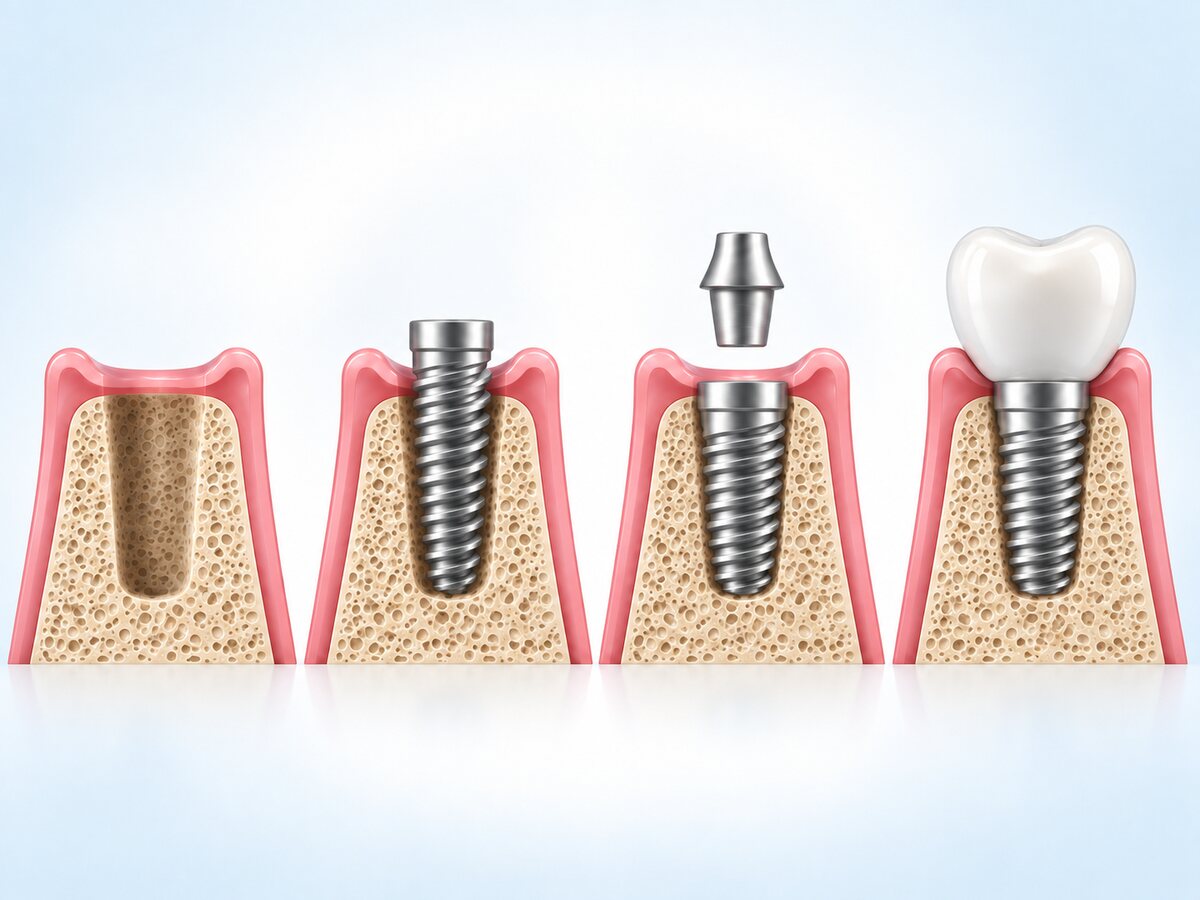
A lot of people are told the same plan by default: tooth comes out, you wait six months for the site to heal, then the implant goes in, then you wait several more months for it to integrate before a crown ever touches it.
Some of that waiting is real biology. Some of it is just waiting.
The clock starts when the implant goes in — not when the tooth comes out
The healing time an implant needs is fixed. What's not fixed is when you start it. Bone doesn't grow onto titanium any faster because you waited six months to place it first. All that waiting did was move your finish line back by six months, for no biological reason.
Where the extraction site allows it, we place the implant the same day the tooth comes out. Not because faster is always better for its own sake, but because every month that gap sits empty is a month you were going to spend waiting anyway — you just weren't earning any healing time during it.
Waiting to start isn't caution. It's just a later finish line.
Why "the same day" isn't always possible
This depends entirely on what the extraction site looks like once the tooth is actually out — whether there's enough healthy bone to support an implant immediately, or whether the site needs grafting first to build up a foundation that isn't there yet. That's a real, case-by-case call, not a marketing line. When same-day placement isn't the right call, we'll tell you why, and what the actual timeline looks like instead.
One tooth vs. a full arch — different math entirely
Single implants and full-arch cases get talked about together because both involve implants, but the timelines are almost opposite, and mixing them up is where most disappointment starts.
A single implant is typically restored three to four months after placement, once it's integrated with the bone. That's it — one tooth, one healing window, one final crown.
A full arch is a different proposition. When four or more implants are placed strategically across an arch and splinted together to support one fixed bridge, the physics genuinely change — this is the case people actually mean when they talk about walking out with a new set of teeth, and it follows its own timeline, not a scaled-up version of the single-tooth one.
What this actually means for you
If you're missing a tooth and you're being told to simply wait, ask why. Sometimes there's a real clinical reason. Often there isn't one, and the wait is just inherited from an old default rather than your actual situation.
Book Find out what's actually true for your teeth.
One consult tells you more than any article can — including this one.
© 2026 Live To Smile. All rights Reserved - Accessibility Statement - Privacy Policy - Sitemap
Managed and Designed by 