To be clear
This is usually a last resort
All-on-4 or All-on-X is usually a last resort for severely compromised dentition — we call it that because it typically means every remaining tooth on the top and/or bottom comes out, many times both arches at once. It's the right call when the teeth that are left can't reasonably be saved short term or long term, not a shortcut for teeth that could still be treated individually with a high probability of success.
How it works
Splinted together, loaded fast
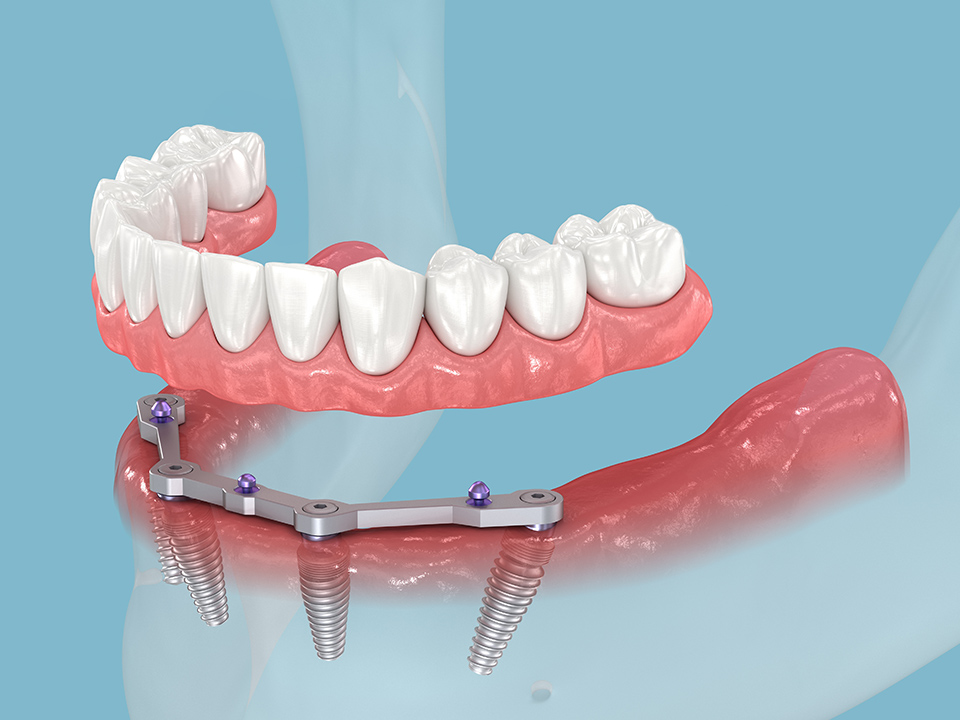
When four or more implants are placed strategically across an arch, the physics change. Splinted together and supporting one fixed bridge, they can typically be loaded with teeth the same day or the next day — rather than waiting months the way a single implant or a short-span bridge must.
Day 0
Surgery
Remaining teeth removed as needed, four or more implants placed.
Same or next day
Fixed teeth
A provisional set is fitted onto the implants. You leave with teeth.
Months later
Final set
Once everything has healed and settled, the definitive bridge is made.
A common question
Why "X" and not just "four"?
All-on-4 became the popular name because four implants, angled strategically, is often enough to support a full arch. But four isn't a magic number — some patients need five or six, depending on bone and bite forces, which is where "All-on-X" comes from. The goal was never to hit a specific implant count. It's to choose the number and position that actually holds up for your bone and your bite, which is why we plan this from your 3D scan rather than picking a number in advance.
The honest part
What we can't promise you
Same-day loading depends on the implants achieving enough initial stability at surgery — that can't be fully confirmed until we're in there. If stability is borderline anywhere in the arch, the safer call is a brief healing period before loading, even at this scale. We'll tell you plainly if that's the situation, rather than force a same-day timeline that risks the result.
Who does the surgery
Sometimes Dr. Carr, sometimes a surgeon we work with
Dr. Carr performs many implant cases start to finish here. Full-arch cases are also where coordinating with a surgeon comes up most — because the anatomy calls for it, because the case is overly complex, or because it simply may increase the odds of a better outcome for that patient. Either way, the planning and the final restoration stay here.
Getting started
How the first visit works
01
Imaging and planning
A 3D scan shows the bone volume, the nerve position and the sinus across the whole arch. That determines the implant count, whether grafting is likely, and what the whole thing will cost — in writing, before anything is scheduled.
02
Surgery day
Remaining teeth removed as needed, implants placed. You'll know before you sit down whether same-day loading is the plan or whether a brief healing period is safer for you.
03
Restoration
Provisional teeth the same or next day in most cases. The definitive bridge is made months later, once everything has settled.
Questions
Before you book
Will I be without teeth at any point?
Typically no. A provisional fixed set of teeth is usually attached to the implants the same day or the next, so you leave with teeth while the final bridge is made later.
Is All-on-4 the same as All-on-X?
All-on-4 is the popular name, but the actual number of implants used depends on your individual bone and bite. All-on-X reflects that the number is planned per case rather than fixed at four.
Am I too old, or is my bone too thin?
Age on its own is rarely the barrier. Bone volume can be, and that is what the 3D scan is for — and part of why the implant count and angulation get planned per case rather than assumed in advance.
Does it hurt?
Most patients report less discomfort than they expected. It is done numb, and sedation options are available — worth discussing given the scale of a full-arch case.
How long do implants last?
Implants themselves commonly last decades. The bridge on top is a normal restoration and may need adjustment or replacement over that span. What threatens an implant most is gum disease around it and uncontrolled grinding, which is why the cleaning schedule and a night guard matter afterward.
Does it matter if I'm on osteoporosis medication?
It can, and it's especially worth raising early for a case this size. Certain osteoporosis medications — bisphosphonates and similar drugs — are linked to slower jaw healing, and that risk tends to rise the longer someone has been on them. Tell us at your first visit; we coordinate with your prescribing doctor before finalizing anything.
Does insurance cover this?
Dental insurance rarely covers All-on-4 treatments. Patients should assume insurance will contribute nothing and plan to pay the full cost out of pocket. We'll explain all treatment fees and available payment options upfront, so you know exactly what to expect before moving forward.
Where exactly are you?
2072 E Southern Ave, A103, Tempe, AZ 85282. This building has three dental offices total — A101, A102, and us at A103 — so double-check the suite number if you're using GPS.
Not quite your situation?
Only missing one tooth? See single implants →
For general information beyond what's here: MouthHealthy.org (American Dental Association), and the Arizona State Board of Dental Examiners, where you can verify any dentist's license.
Book
Ask whether your remaining teeth can be saved — before deciding they can't.
This is a big decision. We'll tell you plainly if a smaller option is actually the right fit.
© 2026 Live To Smile. All rights Reserved - Accessibility Statement - Privacy Policy - Sitemap
Managed and Designed by 