Most people dread this more than the thing itself deserves.
Sedated, you will not remember it. With PRF in the socket, the recovery is usually easier than the stories you have heard. The dread is doing more damage than the procedure will.
PRF
Platelet-rich fibrin: your own blood, working overtim
What is PRF, really?
We take a small blood sample, about the same as a routine blood test, and give it a quick spin in a centrifuge. Out comes a natural fibrin clot loaded with your own platelets, white blood cells, and growth factors. Think of it as your body's healing crew, gathered up and sent straight to the job site: the socket where your tooth used to be after an extraction.
No donors. Nothing synthetic. No additives. Just you, concentrated. And since it's yours, your body already knows it. No rejection worries, no compatibility guesswork.
How PRF helps protect against dry socket
That clot is the bone's bodyguard. It sits in the socket and protects the bone underneath while you heal. When the clot is lost too early, the typical result is dry socket: the complication behind a lot of "my wisdom tooth was a nightmare" stories. PRF may help lower your chances of dry socket and help support a smoother, more comfortable recovery after wisdom tooth removal.
Every body heals a little differently, and no treatment can guarantee a perfect recovery. PRF is one more way we try to tip the odds in your favor.
Optional, and worth asking about
Dr. Carr will offer to put something in the site
It is elective. It costs a little more. Nobody is required to have it and the extraction works fine without it.
But it improves the odds of a smoother, faster recovery — and the honest reason we bring it up is simple: it is what Dr. Carr would do for his own family sitting in that chair. If you would rather skip it, say so and we will not raise it twice.
Comfort options
IV sedation is one option. Not the only one.
Some patients want to be fully out. Others would rather not have an IV, and that is a completely reasonable preference — Dr. Carr can get you a great experience without one. Four ways to do this, and none of them is the wrong answer if it is the one that gets you in the chair.
Local anesthetic only
Numbing injection, fully awake. You feel pressure but not pain. No driver needed, no recovery period, nothing to plan around. Perfectly reasonable for a straightforward extraction if dental work does not bother you.
Local plus nitrous
Nitrous oxide through a small nose mask on top of the numbing. It takes the edge off within minutes, you stay awake and talking, and it clears within minutes of coming off it — so in most cases you can drive yourself home. A good middle step for mild nerves.
Local plus an anti-anxiety pill
An optional oral sedative — Halcion or Xanax — taken before the appointment, with local anesthetic for the extraction itself. You stay awake, but the anxiety comes off substantially.
Halcion has a particular advantage worth knowing about: it commonly causes short-term memory loss. So you could be sitting there perfectly relaxed, chatting away and having a fine time, and simply not remember much of it afterward. For patients whose dread is really about the memory of dental work, that is often exactly what they were hoping for.
You will need someone to drive you both ways, and you should not make important decisions or be alone for the rest of the day.
IV sedation
Medication through an IV line, monitored throughout. The deepest option — most patients remember little or nothing at all. Usually the right call for all four wisdom teeth at once, for difficult impactions, or for patients whose anxiety has kept them away for years.
Requires a driver and the rest of the day off.
Tell us at the consult which of these sounds right and we will build the appointment around it. Bring a full list of your medications and health conditions either way — some of them change which options are available to you.
How it goes
Three visits, usually
01
Consult and X-ray
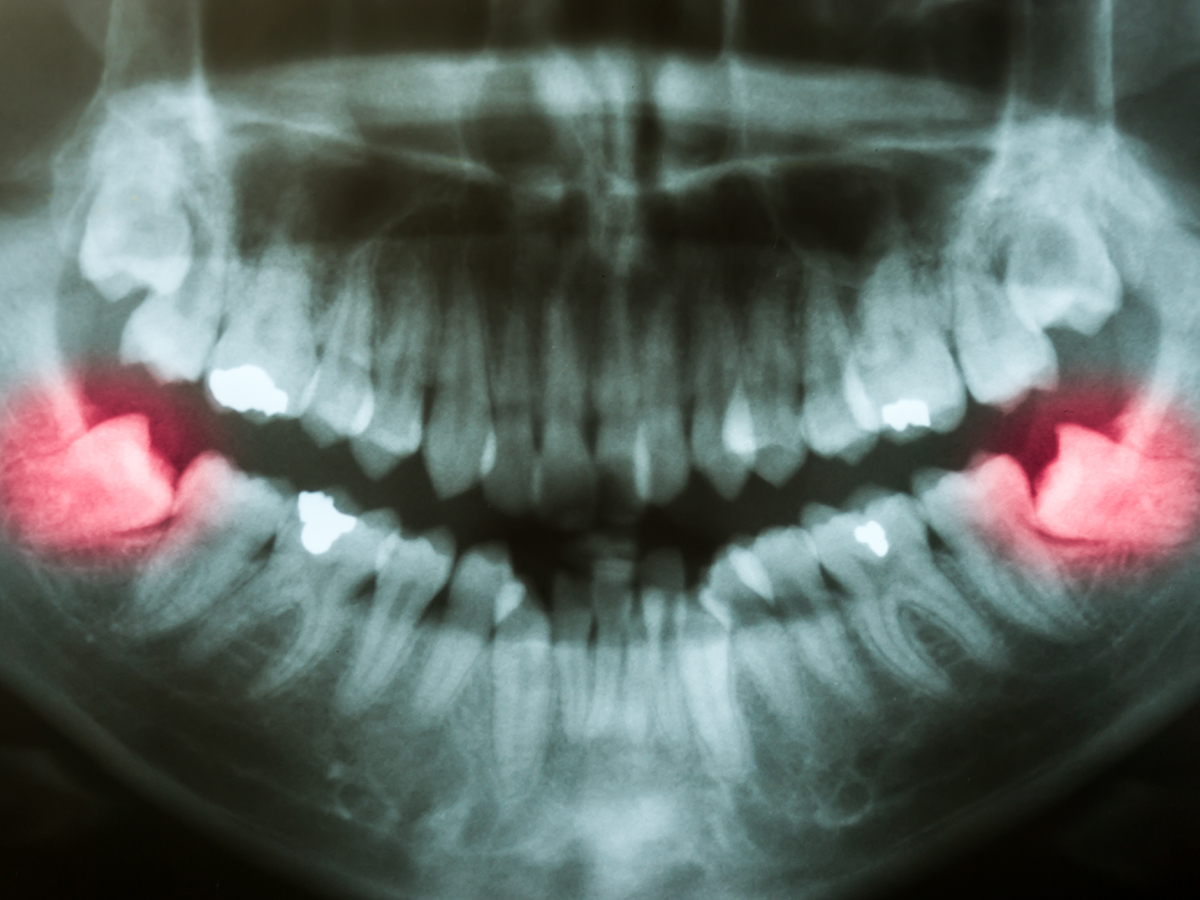
A panoramic X-ray shows where the roots sit relative to the nerve and the sinus. That determines difficulty, sedation choice, and price — all of which you get in writing before anything is scheduled.
02
Surgery day
Blood drawn and spun for PRF, sedation started if you chose it, teeth removed, PRF placed in the sockets, sutures if needed. Plan for someone to drive you and for the rest of the day off.
03
Follow-up
A check to make sure the sites are healing as expected and to remove sutures if they are not the dissolving kind. Call before then if anything worries you — that is what the number is for.
Afterwards
Protect the clot. That's most of it.
Nearly every wisdom tooth horror story comes down to a lost clot. These are the things that dislodge one.
First 24 hours
Do not disturb the site
- No straws — the suction is what pulls the clot out
- No smoking or vaping, for the same reason plus the healing hit
- No spitting or forceful rinsing
- Bite on gauze as directed, and resist the urge to keep lifting it to check
- Ice on the outside of the cheek, 20 minutes on and 20 off
Days 2 to 7
Gentle everything
- Warm salt-water rinses, gently — let it fall out of your mouth rather than spitting
- Soft food, nothing sharp or crunchy near the sites
- Keep brushing the rest of your mouth normally
- Swelling usually peaks around day two or three, then improves
Call us
When something is not right
Pain that gets worse around day three to five instead of better is the classic dry socket pattern — that is a call, not something to wait out. Same for a bad taste that will not clear, bleeding that has not settled after an hour of steady pressure, or fever. Spreading swelling or difficulty swallowing is an emergency room, not us.
Who does it
Your surgeon
Dr. Woodmansee
Third molars · IV sedation · PRF
Focuses primarily on third molar extractions at George Carr DDS & Associates PLLC. Offers IV sedation so the appointment is something you get through rather than something you dread, and uses PRF on extraction sites to support healing.
Questions
Before you book
Do they all have to come out?
No. Wisdom teeth that are fully erupted, in a good position, cleanable and not causing problems can often stay. The X-ray tells us which ones you have. We would rather leave a tooth that is behaving than take four because it is the default answer.
Does insurance cover it?
Usually in part — this is oral surgery, not cosmetic treatment, so it typically falls under coverage. IV sedation is sometimes covered and sometimes not, depending on the plan and the medical necessity. We check your specific plan and give you the number before we schedule.
Am I too old for this?
Older patients do heal a bit slower and roots are often more fully formed, which can make extraction more involved. But there is no age at which it stops being an option, and an infected or impacted tooth does not get easier by waiting.
Can I go to work the next day?
Many people do, especially with a simple extraction. Plan on taking it easy the day of, and do not schedule anything demanding for the day after if you can avoid it. Everyone recovers a little differently.
I don't want an IV. Can I still do this?
Yes. Dr. Carr does these with local anesthetic or an optional anti-anxiety pill, and patients do very well. Not wanting an IV is a normal preference, not something to talk you out of.
Will I really not remember it?
With Halcion, often not much. Short-term memory loss is a common effect of it, which in this setting is a feature rather than a side effect — you can be relaxed and chatting through the whole appointment and still have very little recollection of it the next day. It is not guaranteed, and it varies by person.
Is the healing material extra?
It is elective and it does cost more, and you will see exactly what is and is not included in the written quote before anything is scheduled. No surprise line items afterward. If you would rather not have it, the extraction goes ahead without it.
Where exactly are you?
2072 E Southern Ave A103, Tempe, AZ 85282. Two other dental offices share this building — Suites A101 and A102 — so look specifically for A103.
For general information beyond what's here: MouthHealthy.org (American Dental Association), and the Arizona State Board of Dental Examiners, where you can verify any dentist's license.
Book
Find out which ones actually need to go.
An X-ray and a straight answer. If some of them can stay, we will tell you that.
© 2026 Live To Smile. All rights Reserved - Accessibility Statement - Privacy Policy - Sitemap
Managed and Designed by 