The difference
Three ways to get a straighter, whiter smile
No-prep, minimal-prep, and traditional veneers all use similar porcelain. What changes is how much of your natural tooth we touch to get there — and that depends on what your teeth are actually doing before we start
No-prep
Zero enamel removed. Best when teeth already sit close to where they need to be.
Minimal-prep
A small amount of enamel is removed. For teeth that sit slightly forward, are crowded, or are too bulky for no-prep to sit naturally.
Traditional / porcelain — you are here
More reduction, more correction is possible. For bigger changes in shape, color, or alignment.
More correction means more room to work with — not more dentistry for its own sake.
Traditional veneers exist for the cases where a thin layer of porcelain genuinely isn't enough to get you where you want to be. That's not every case — but for the ones it fits, it's the most complete answer we have.
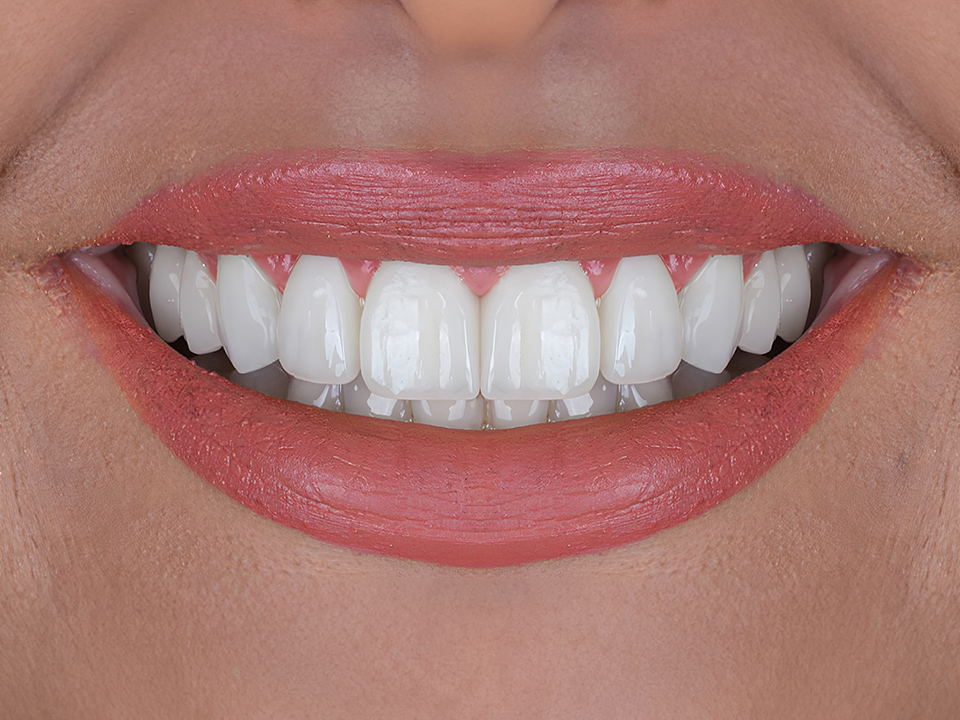
Actual patients of Dr. George Carr
Our work
Candidacy
Are you a candidate?
This is usually the second stop for people whose no-prep consult turned up something that needed a bit more room.
Usually a good fit
- Wants the most complete possible change in shape, color or alignment
- Correction needed is more than minimal-prep can achieve
- Teeth are healthy and structurally sound underneath
- Comfortable with the most involved of the three options
Needs a closer look first
- A tooth that's had a root canal, or has darkened from within — this is the case a veneer struggles with most. A thin layer of porcelain often can't fully block a dark tooth from showing through. A crown, which fully covers the tooth, almost always handles it better. See how below.
- Large fillings, cracks, or more filling than natural tooth left — also a crown conversation
- Only a small correction actually needed — no-prep or minimal-prep may get you there with less removed
When a crown does what a veneer can't
A veneer covers the front surface of a tooth. A crown covers the whole thing. That difference matters most on a root-canaled tooth, which tends to darken from the inside out — a veneer's thin porcelain often can't fully block that discoloration, but a crown's opaque core can.
With today's materials — a zirconia core layered with hand-finished feldspathic porcelain — a crown can look every bit as natural as a veneer sitting right next to it. We've had cases with two crowns next to four veneers where even the patient couldn't tell which teeth were which once we were done.
See how we handle darkened and root-canaled teeth on the Dental Crowns page →
Pricing · per tooth
Real numbers, before you call.
Traditional veneer pricing often lands in the same range as no-prep and minimal-prep. Technique isn't the only variable that drives the cost — material and complexity matter too — but the odds are the price ends up very similar either way.
$1,300–$1,700per tooth
These will be estimates. Your exact figure is confirmed at your consult, in writing, before anything begins. Dental insurance does not pay for aesthetic treatment.
The process
How it actually goes
Visit 1
Consultation, smile design and impressions
We plan the full shape and shade change together before any tooth is touched, so you know what you're signing up for.
Visit 2
Prep visit — full veneer reduction
More enamel is removed than no-prep or minimal-prep, always with local anesthetic. Temporaries protect the teeth while your final veneers are fabricated.
Visit 3
Try-in of your final veneers, then bonding
We check fit, shade and bite before permanently bonding, with anesthetic used again for comfort.
Questions
Before you book
How is this different from no-prep or minimal-prep?
All three use similar porcelain. The difference is how much of your natural tooth is reshaped first — traditional veneers remove the most, which is what allows the most correction in shape, color and alignment.
What if I actually need a crown instead?
It's a genuinely different question from "which veneer." A root-canaled or structurally compromised tooth usually holds up better and looks more natural with a crown than a veneer — we'll tell you plainly at your consult if that's what we're seeing.
Will people be able to tell they're veneers?
Not when they're done well. The materials we use — the same e.max, LiSi, and feldspathic porcelain used across all our veneer options — are designed to read as natural tooth, not as a cosmetic add-on.
For general information beyond what's here: MouthHealthy.org (American Dental Association), and the Arizona State Board of Dental Examiners, where you can verify any dentist's license.
Book
See what's actually possible for your smile.
We'll walk you through all three veneer options honestly, including which one fits your case — and whether a crown is really the better answer.
Prefer to call? (480) 756-0194
© 2026 Live To Smile. All rights Reserved - Accessibility Statement - Privacy Policy - Sitemap
Managed and Designed by 