
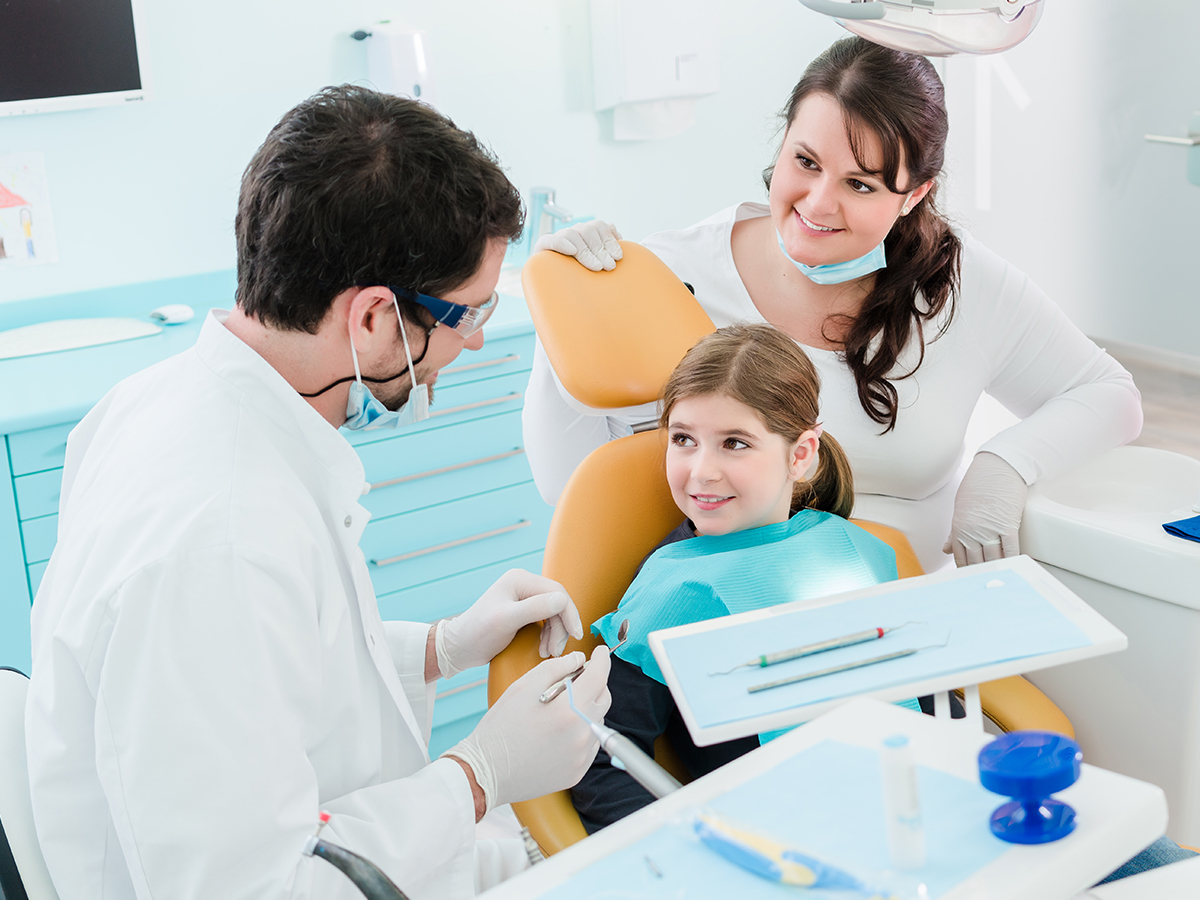
The cheapest dentistry you will ever have is the dentistry you didn't need.
Two cleanings a year and an X-ray that catches something at 2mm instead of 6mm is not an upsell. It is the entire reason this side of the practice exists.
What we do here
Most of what your mouth can throw at us
If a specialist is the better choice, we send you. Otherwise, the goal is to keep your care, records, and plan in one place.
Cleanings and exams
Every six months for most people, more often if you have gum disease or heavy buildup. Includes X-rays on the schedule your history calls for, not on a fixed rotation.
Fillings
Tooth-colored composite, shade-matched. On front teeth we treat the shade and the contour as a cosmetic problem, because that is what it is.
Root canals
Often done the same visit you are seen when you are in pain, rather than scheduled out weeks on antibiotics. A crown usually follows to keep the tooth from cracking.
Crowns
Full coverage for a cracked, broken-down or root-canaled tooth. Often the same porcelain used in our veneers — and reinforced with a stronger core for heavy grinders or to mask a darkened tooth underneath.
Extractions and wisdom teeth
Third molars handled by Dr. Woodmansee, with IV sedation available and PRF placed in the socket to support healing.
Implants and bone grafts
Placed at the time of extraction when the site allows it, so it is one surgery instead of two. Grafting when the bone needs rebuilding first.
Gum treatment
Deep cleaning and laser therapy for gum disease. This gets handled before any cosmetic work — veneers bonded onto unhealthy gums is a problem waiting to happen.
Orthodontics
Clear aligners and traditional options. Sometimes moving teeth first means far less dentistry later — occasionally it means none at all.
Who you'll see
One set of records, whoever you see
Not every dentist here is in every day, and we will tell you who you are booked with. What does not change is that your history stays in one place instead of being posted across town.
Dr. Orlando
General dentistry
Exams, cleanings, fillings and the routine visits that keep small problems from turning into big ones.
Dr. Youkel
General dentistry
Also on the family side. Between him and Dr. Orlando the schedule stays open enough that a checkup does not take three weeks to book.
Dr. Woodmansee
Sedation extractions · Wisdom teeth
Typically handles our sedation extractions, including wisdom teeth, with IV sedation available and PRF spun from your own blood placed in the socket to support healing.
George Carr
DDS · Owner · Since 2002
Cosmetic and restorative work — veneers, gum lifts, crowns, and rebuilding a bite that has worn down over the years.
In detail
The everyday work, explained properly
Cleanings & exams
Six months is a default, not a diagnosis. Some mouths need three. Some genuinely don't need more than six — we'll tell you which one you are and why, rather than putting every patient on the same recall because it's what the software defaults to. Most of what we catch at a cleaning is cheaper to fix at a cleaning than it will ever be again. A cavity caught at 2mm is a filling. The same cavity found at 6mm is a root canal and a crown — the dentistry doesn't get less expensive by waiting, it only ever gets more.
If we say you need a deep cleaning, it's a different procedure, not an upsell tier. A regular cleaning removes buildup at and just below the gum line. A deep cleaning — scaling and root planing — cleans the root surfaces down inside periodontal pockets where a regular cleaning instrument doesn't reach. We'll show you the pocket depths we measured rather than just telling you the answer. If the numbers don't support it, you don't need it.
Fillings
Caught early, a cavity is one visit — not a project. Composite fillings bond directly to the tooth and are shaded to match it, so most people can't spot one once it's polished. The earlier a cavity is caught, the smaller the filling — which is most of the argument for regular checkups.
Older amalgam fillings required removing extra healthy tooth structure just to hold the material in mechanically, and they never blended in. Composite works differently — it chemically bonds to the tooth, so less healthy structure has to be removed to make room for it, and it's mixed and layered to match your existing tooth color rather than standing out.
Decay doesn't stop on its own. What starts as a filling can turn into a crown, or a root canal, purely on a timeline. A small cavity caught at a routine cleaning is a straightforward filling. Left alone, it can reach the nerve, and what would have been a filling becomes a bigger visit, more cost, and more time in the chair.
Root canals
The root canal isn't the pain. It's what stops it. Almost everything people fear about this procedure is a description of the infection that precedes it — the treatment is what removes that. When you arrive in pain, the appointment that diagnoses it is frequently the same appointment that ends it.
Antibiotics do not reach inside a dead tooth. The inside of a tooth with a dying or dead nerve has lost its blood supply, so medication only knocks back the swelling around it — which is why you feel better for a week or two, but it comes back, often worse. There's a place for antibiotics — a spreading infection, significant swelling, a medically compromised patient — but not as a substitute for treating the tooth itself.
Nothing replaces your own tooth. An implant is excellent dentistry and sometimes the right answer, but your own root in your own bone, saved when it could be saved, is still the best thing in your mouth. A crown usually follows to keep the treated tooth from cracking, since it's more brittle afterward.
Gum disease
Caught early, it's a cleaning. Left alone, it's bone loss. Gum disease starts quietly — bleeding when you brush, a little puffiness — and gets expensive and irreversible the longer it's ignored. A cleaning doesn't undo damage instantly, but it stops the disease process and gives your gums the best shot at healing, which is most of the battle in every case we see.
Treatment matches the stage. Gingivitis — inflammation only, no bone loss yet — is typically reversible with a proper cleaning and better home care; this is the stage worth catching. Periodontitis — where bone and ligament have started to break down — needs deep cleaning below the gumline (scaling and root planing), sometimes with a locally applied antimicrobial. Advanced periodontitis, with significant bone loss and teeth that may feel loose, typically needs surgical treatment beyond a standard cleaning, which may include referral to a periodontist.
Gum disease is manageable, not cured outright — regular periodontal maintenance is how it's kept from coming back.
Bone grafting
An implant is only as good as the bone holding it. Bone starts to resorb — shrink — within months of a tooth being lost or an infection running its course. A graft replaces that lost volume with a scaffold your own body grows into, so there's something solid for an implant, or the tooth next door, to stand on.
We typically use one of two materials. Allograft bone — processed, sterilized human bone from a screened donor — acts as a scaffold your body remodels into your own living bone over time. Collagen-based graft material is used right after an extraction, keeping the socket from collapsing while it heals so the ridge can support a future implant, bridge, or denture.
A graft is a wait, not a shortcut. The material is a scaffold, not instant bone — your body has to grow into it on its own timeline, commonly three to four months for a site-preservation graft, longer for larger defects. We won't rush an implant into a graft that hasn't matured.
Insurance
The part insurance is more likely to help with.
Usually covered
- Cleanings and routine exams
- X-rays
- Fillings
- Root canals
- Extractions and wisdom teeth
- Crowns, in part
- Gum disease treatment
Usually not covered
- Veneers of any kind
- Gum lifts done for appearance
- Whitening and bleaching
- Enamel recontouring
- SmileReveal
- Cosmetic bonding
Why we spell this out
Dental insurance does not pay for aesthetic treatment. We would rather you hear that from us now than find out later. The flip side is the part nobody tells you either: nearly everything on this page is covered at least in part, and cleanings are often covered outright. Call and we will check your specific plan before your visit.
Questions
Before you book
How often do I really need a cleaning?
Every six months for most people. If you have gum disease, heavy tartar, diabetes, or a history of periodontal treatment, three or four months may be the honest answer. We will tell you which one you are, and why — not put everyone on the same schedule.
Do you see kids?
Yes, alongside adults, and we can often schedule a family together rather than making you come back three separate times.
I haven't been to a dentist in years. Is that a problem?
It is more common than you think and it is not a lecture. We look, tell you what is going on, and sort it into what needs doing now and what can wait. Nobody here is going to make you feel bad about the gap.
Do I need X-rays every visit?
No. Frequency depends on your risk and your history — someone with no decay in a decade does not need the same schedule as someone with active problems. We take them when they will actually change a decision.
What if I need something you don't do?
We refer it out and tell you why. We handle almost everything in this building, but "almost" is honest — when a case genuinely belongs with a specialist, sending you there is the right answer.
Where exactly are you?
2072 E Southern Ave A103, Tempe, AZ 85282. Two other dental offices share this building — Suites A101 and A102 — so look specifically for A103.
Book
Start with a cleaning. We'll take it from there.
We will tell you what needs doing now, what can wait, and what does not need doing at all.
© 2026 Live To Smile. All rights Reserved - Accessibility Statement - Privacy Policy - Sitemap
Managed and Designed by 