That's the whole idea behind prepless veneers — no drilling away healthy enamel. Just ultra-thin porcelain bonded over the teeth you already have.
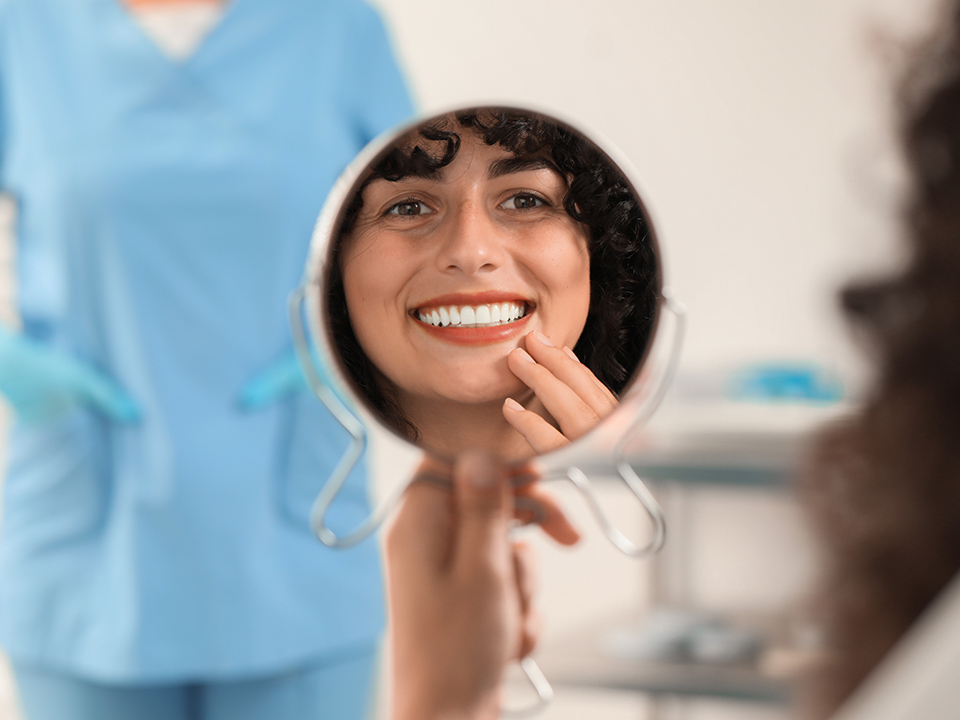
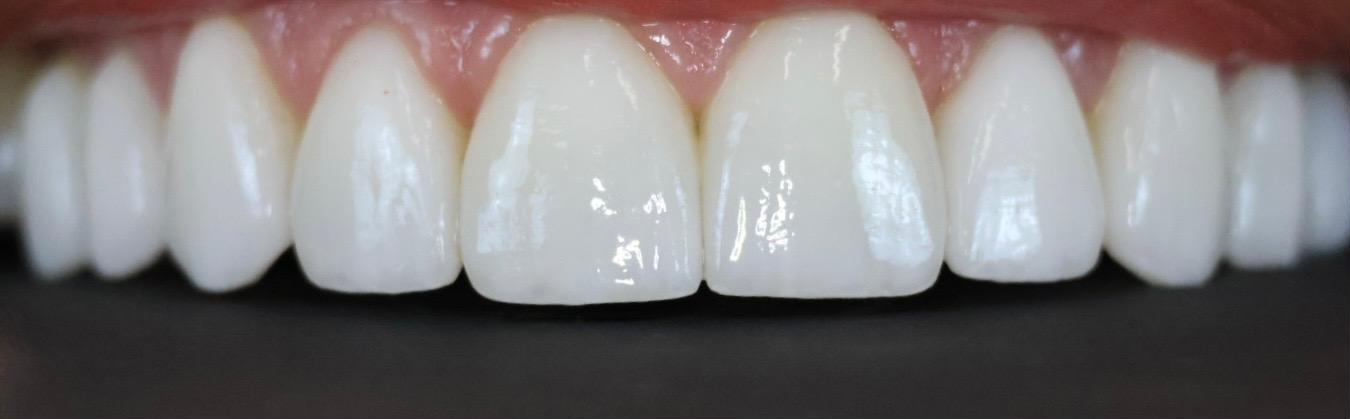
Do not forget: enamel doesn't grow back. So why take it away.
Our goal is a dramatic result with the gentlest path to get there.
The difference
No-prep vs. minimal-prep vs. prepless veneers
No-Prep
Minimal-Prep
Traditional
Enamel removed
Minimal
Significant
Anesthetic to prep
Not usually
Yes
Best for
Teeth close to ideal
Bigger corrections
About comfort
Our goal is to prepare your teeth without anesthetic at all — with true no-prep, there's often nothing to numb. We do typically numb you on the day we seat and bond the final veneers, for your comfort during a longer, more precise appointment.
That's the whole difference. Traditional veneers need anesthetic because healthy enamel is being cut away. Here, if you're numb, it's because we want you comfortable — not because we're taking something from you.
No-prep veneers, non-prep veneers and prepless veneers are all the same thing — the terms are interchangeable. In our office we typically say no-prep.
We also consider minimal-prep part of the no-prep and prepless family, because we're not preparing teeth the way traditional veneers do. No anesthetic to remove enamel. And what little enamel comes off is insignificant next to a traditional veneer, where healthy tooth is cut down all the way around.
Minimal-prep is what we use when teeth aren't in the ideal shape or position for true no-prep. It isn't a compromise on the result — it's what gets the result right when the starting point isn't perfect. We may want to soften a sharp corner, for instance, or reduce a part of a tooth that sticks out where we'd rather it didn't.
Want the details on either option? See minimal-prep veneers or, for bigger corrections, traditional porcelain veneers.
At your consult, we'll tell you honestly which one your case calls for.
Same mouth · same light · same second
This is what a no-prep transformation can look like.
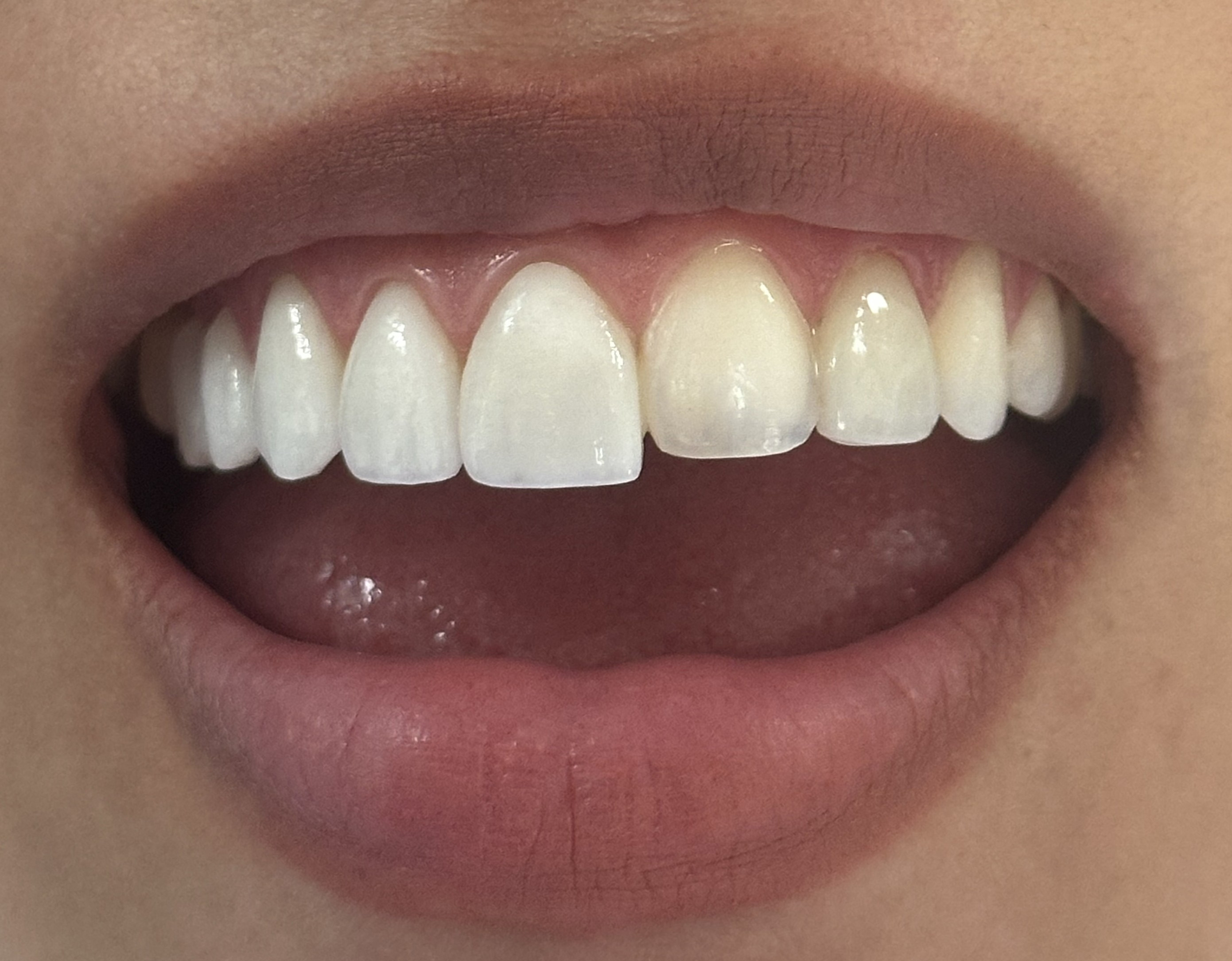
No-prep & minimal-prep veneers · try-in stage
Four veneers tried in on one side. Her own teeth on the other. Same mouth, same light, same second. Nothing to argue with.
Now look at the two front teeth. The one on the left is longer. Fuller. Brighter. That length wasn't an accident — that length was a choice. We could have gone shorter. We offered shorter. She didn't want shorter.
She wanted her song. Her confidence. Her brilliance. Her hello. Her bling. She wanted her whole smile to live big and bright.
She is living to smile.
So that's what we built. Not a textbook ideal. Not my idea of the perfect tooth. Hers.
This case combined no-prep and minimal-prep — the two go hand in hand, and both keep as much of her own enamel as we possibly can. Because enamel doesn't grow back. So why take it away.
Try-in stage, with some of her veneers in place. Her final came out beautiful — and she loves them.
Want to see what this would look like on your teeth? That's exactly what the try-in is for.
Actual patients of Dr. George Carr
Our work
Case study
Feldspathic veneers — no-prep and minimal-prep combined
One case, both approaches. Where the teeth were already in good position we placed true no-prep feldspathic veneers; where they weren’t, minimal-prep got them right. Hand-layered by a master ceramist, and about as thin as a veneer gets.
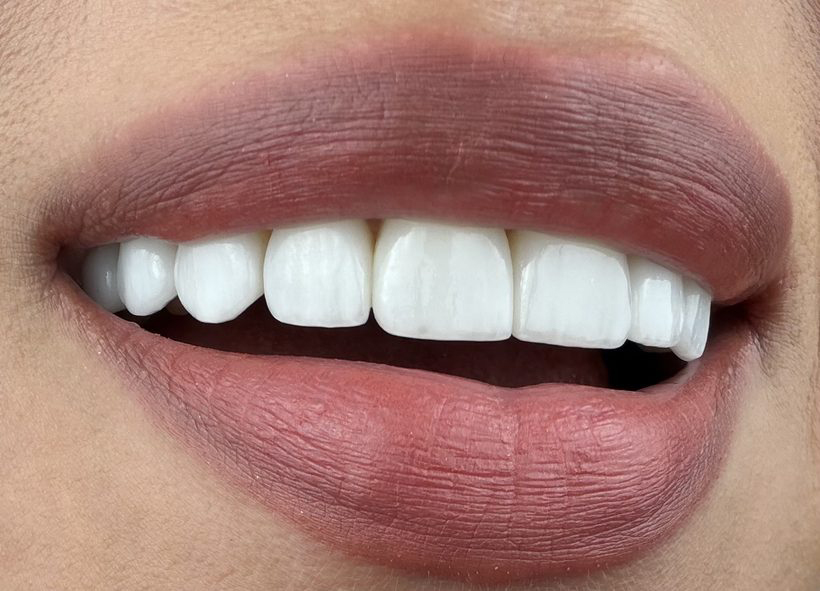
Feldspathic veneers · one light
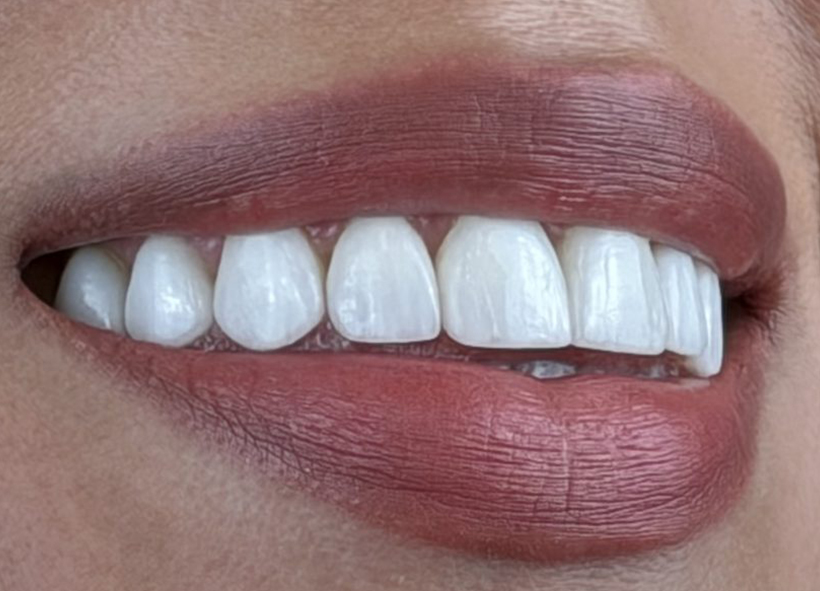
The same veneers · another light
Nearly the same photo, on purpose. Feldspathic catches light differently from every angle — brighter here, softer there, never a flat sheet of white. That shifting is what makes a veneer read as a living tooth instead of a shell.
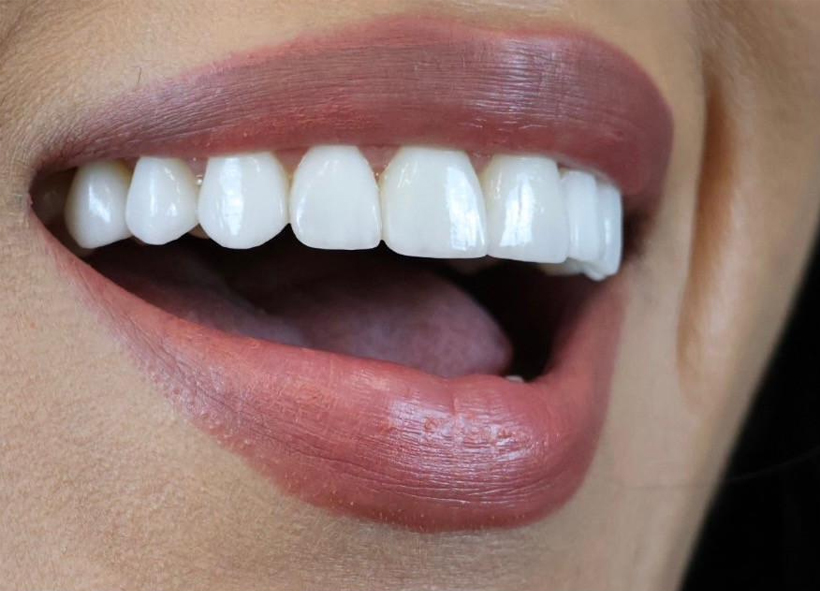
Minimal-prep · gum lift · feldspathic veneers
Case study · gum lift
The frame before the picture
Low gums make teeth look short no matter how well the veneers are made. Reshaping the gum line first sets the frame — then the veneers go on. Same visit, no anesthetic to remove enamel.
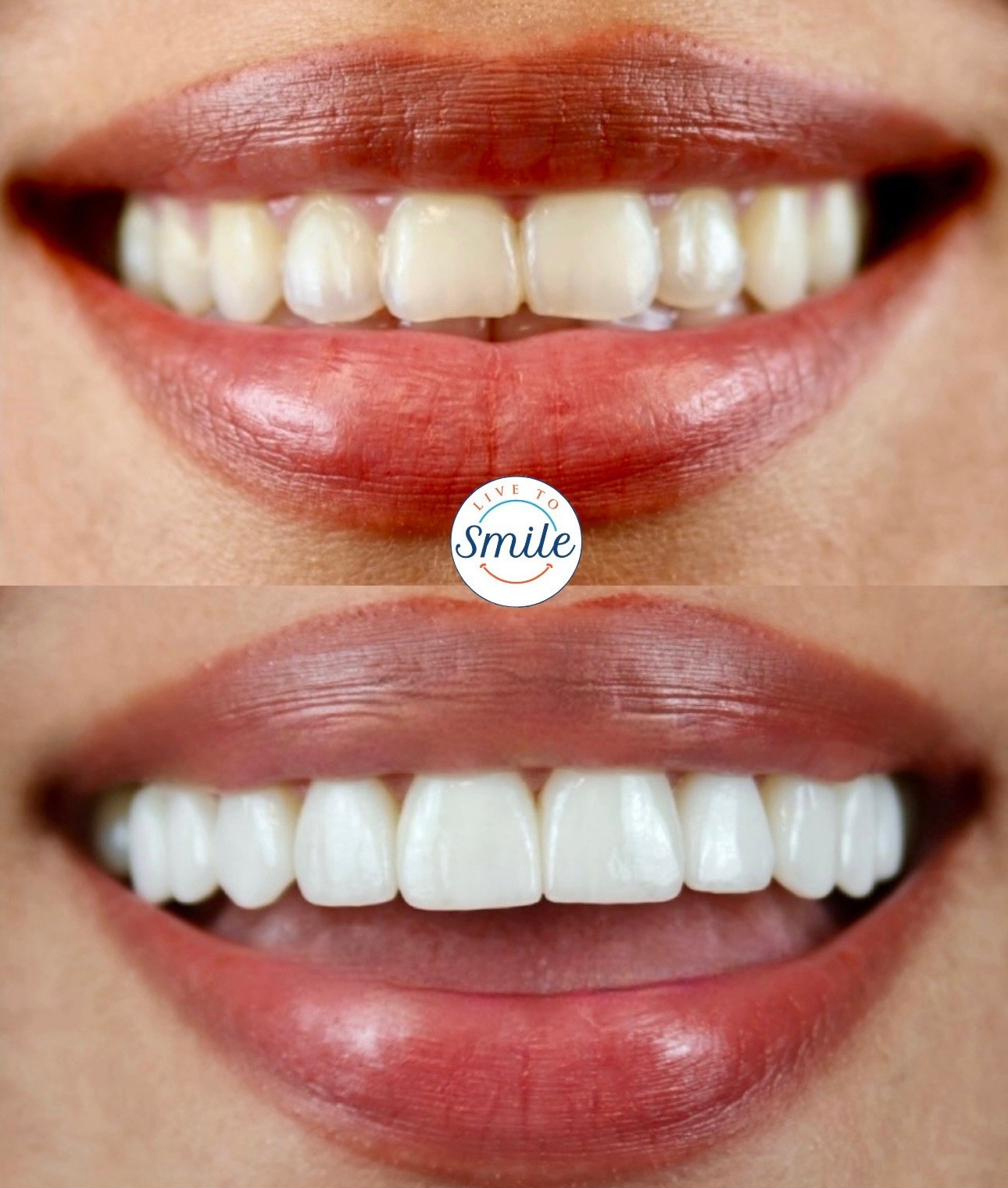
Before and after · no-prep veneers with gum lift
Case study · Neer hybrids
Composite and porcelain, printed rather than layered
Neer hybrids with porcelain veneers and a gum lift. Part composite, part porcelain — thinner than full porcelain, stronger than bonding, and the most affordable way into a full case. Look at what changes above the teeth, not just the teeth.
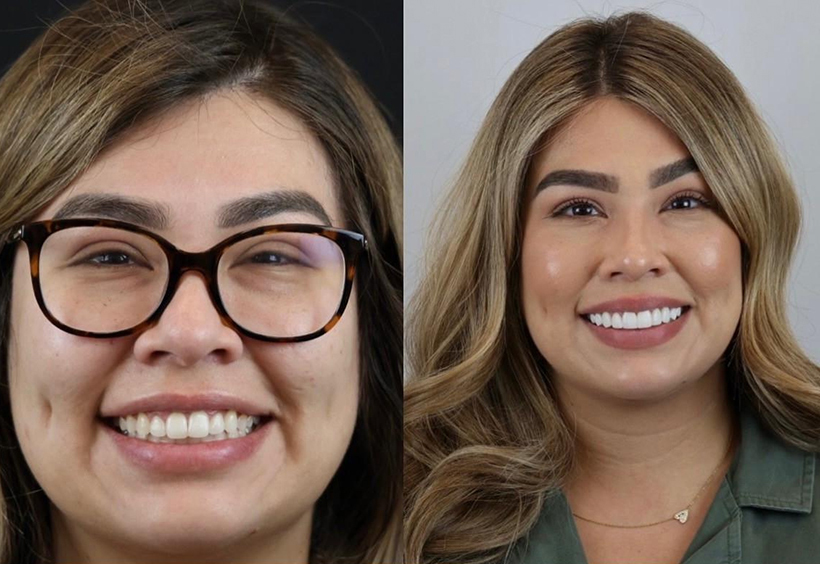
Before and after · Neer composite hybrids, porcelain veneers and gum lift
Case study
No-prep porcelain LiSi veneers and onlays, with the bite opened back up
Porcelain LiSi veneers and onlays — a material very close to e.max. Years of wear had closed his bite down; we restored that height and the shade at the same time, without cutting the natural teeth down.
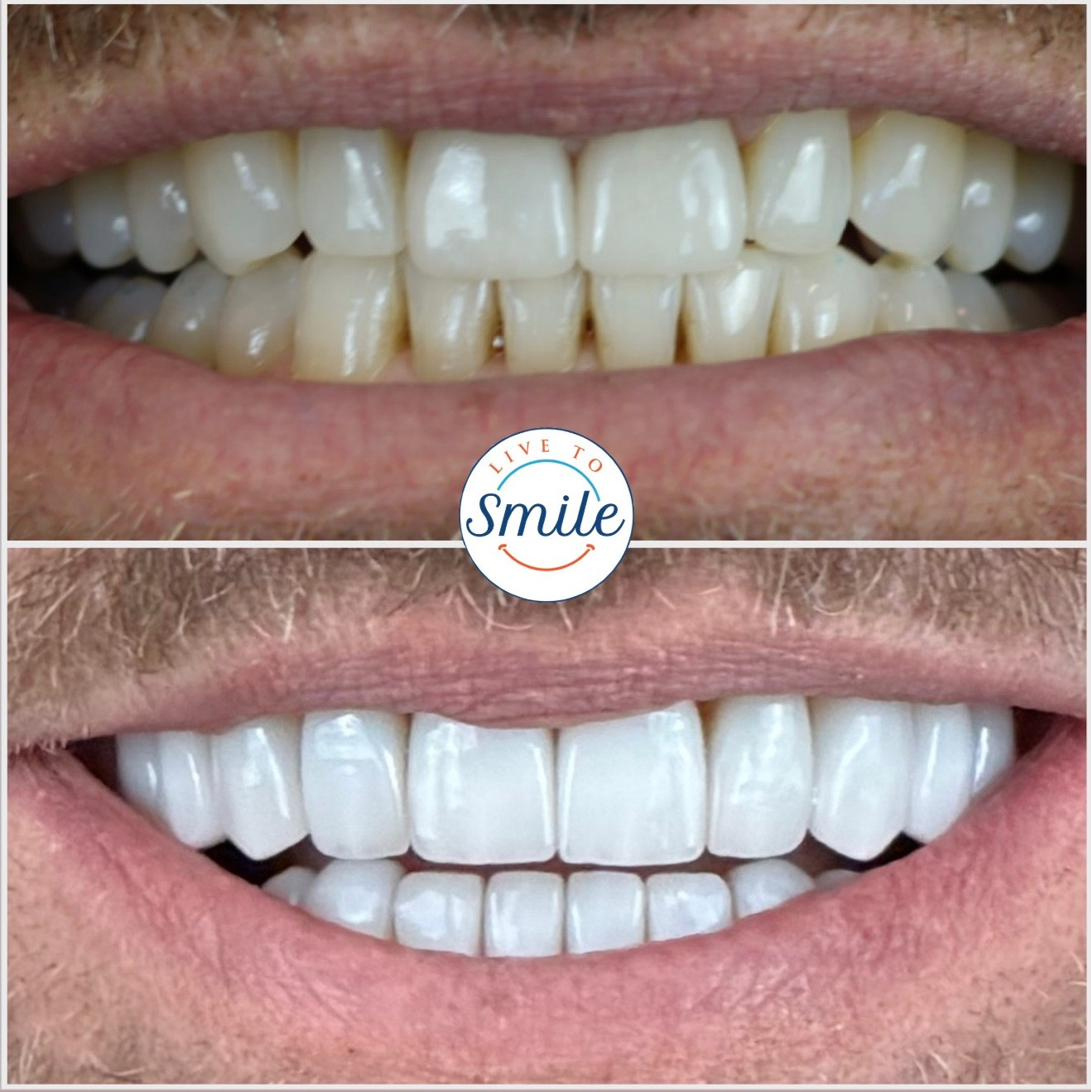
Before and after · no-prep LiSi veneers and onlays
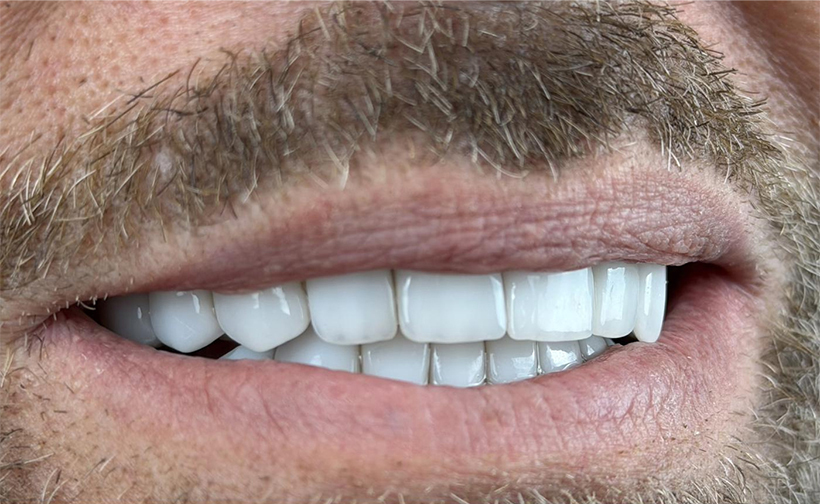
Finished · side view
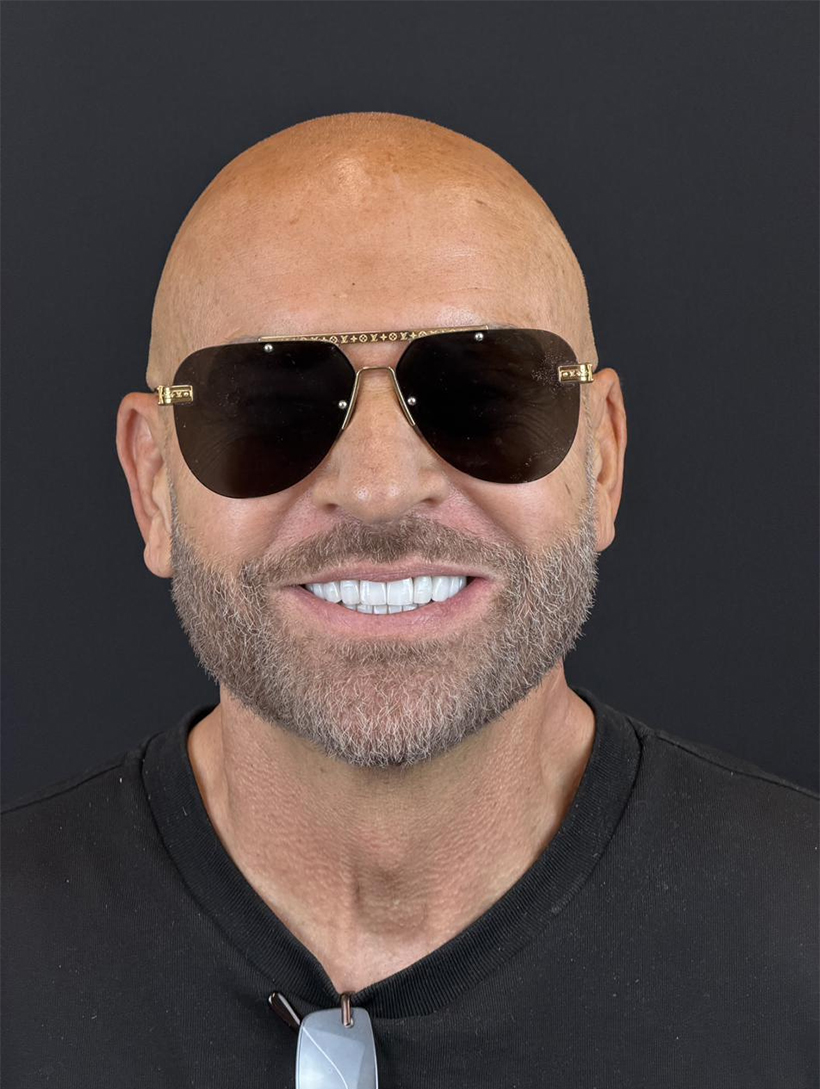
The whole face · vertical dimension opened
Case study
e.max veneers — no-prep and minimal-prep combined
One case, both approaches. Where the teeth were already in good position we placed true no-prep e.max veneers; where they weren’t, minimal-prep got them right. We did this after a try-in first — wax-up, mockup, test drive, or the moment, depending on the case — so the patient knew exactly what they were getting before anything was final.
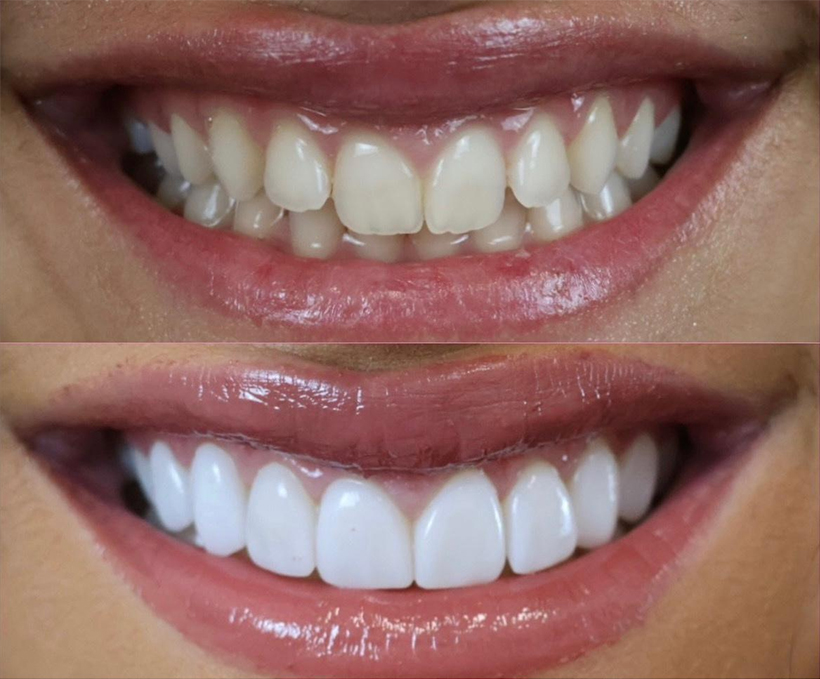
Before and after · no-prep e.max veneers
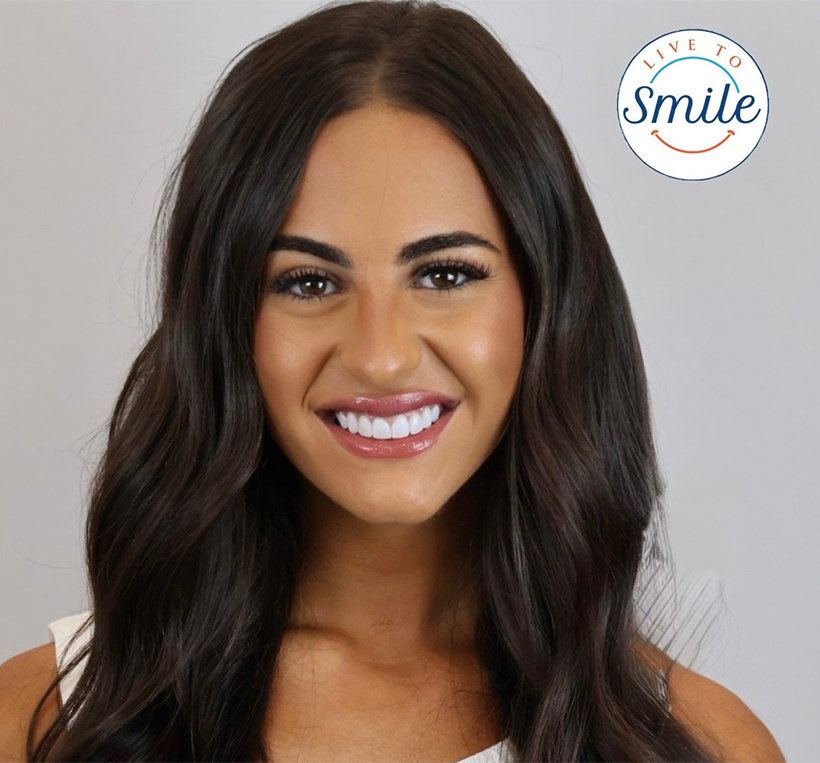
The whole face · finished e.max veneers
Case study · peg laterals
Two teeth. A whole new smile.
We treated exactly two teeth on this patient — the laterals, #7 and #10. Everything else in these photos is her own untouched enamel.
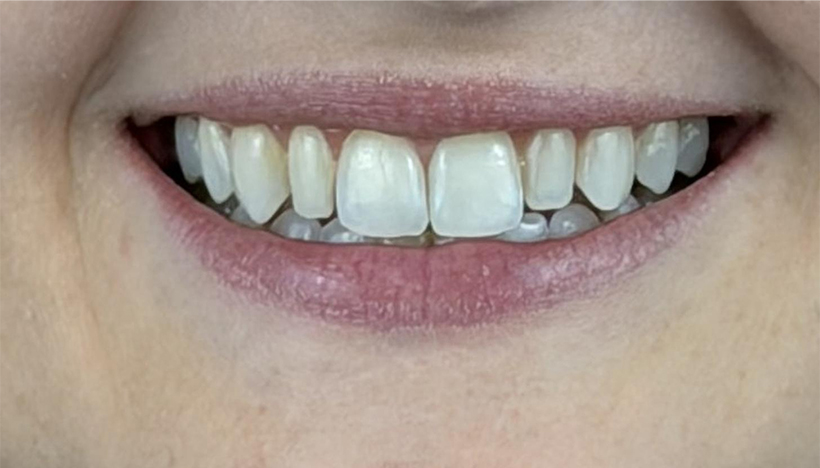
Before
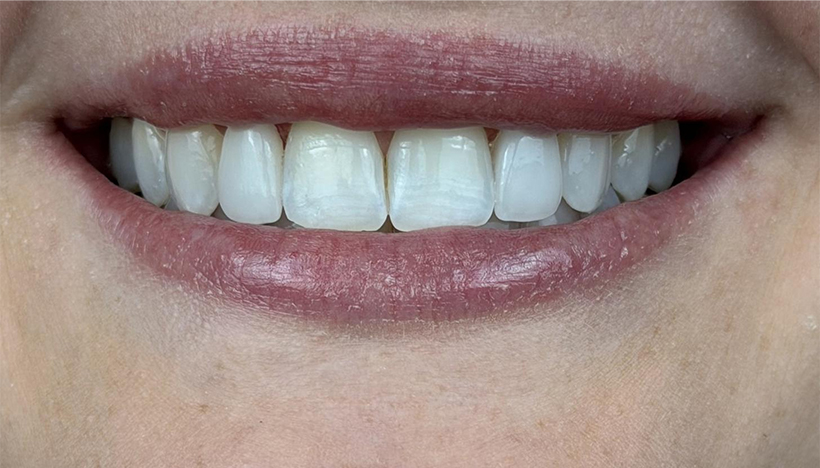
After · two feldspathic veneers
Peg laterals are the two teeth flanking your front teeth that come in genetically undersized. They leave dark triangles of shadow on either side of the smile, and because the eye reads a smile as one continuous line, two small teeth make the whole arch look uneven — even when every other tooth is fine.
This is minimal-prep, not true no-prep. Building width onto a pointed tooth without reducing it first just makes a bigger pointed tooth. Reducing a small amount of enamel let the ceramist land the veneer on the right form instead of padding out the wrong one — still no anesthetic to remove enamel, still nothing like a traditional prep.
She test drove the shape first in temporary draft veneers before anything was permanent. The result is excellent by our standards — and more importantly, by hers.
Why this case matters
Look at the after photo and count how many teeth you think were treated. Most people guess six or eight. It was two. Filling the two gaps at the corners closed the smile into one continuous line, and the teeth she already had suddenly read as fuller and more even.
Not every case needs a full arch. Sometimes the right two teeth do the work of ten — for a fraction of the investment. At your consult we’ll tell you honestly which one you’re looking at.
★★★★★
“Dr. Carr truly transformed my smile, and I could not be happier with the results! You can tell he genuinely takes pride in his work and is committed to creating a beautiful, natural, and personalized result.”
Google review · the peg lateral patient above
Two things people notice but can't name
Vertical dimension. The height of your face when your teeth come together. Years of wear and grinding gradually close it down, which shortens the lower face and deepens the lines around the mouth. Rebuilding the teeth can open it back up.
Gum lift. Also called a gingivectomy. If your gums sit low, your teeth look short no matter how well the veneers are made. Reshaping the gum line first — a quick, minor procedure — sets the frame before anything is bonded. Several of the cases above included one.
Gum lifts are $100 per tooth — and included at no charge when you have 4 or more porcelain veneers done at once.
Six case studies, one question left — what would yours look like?
Candidacy
Are you a candidate?
Usually a good fit
- Small, short, or worn teeth
- Gaps and spacing you'd like closed
- Mild crowding or rotation
- Discoloration whitening didn't fix
- Healthy gums, no active decay
Needs a closer look first
- Heavy grinding or clenching
- Significant bite or alignment issues
- Active gum disease
- Teeth that already sit excessively forward
- Large fillings or previous crown work
If you're in the second column, that isn't a no. It means we look carefully first and tell you what's realistic before you spend anything.
Pricing · per tooth
Real numbers, before you call.
These are no-prep, prepless and minimal-prep veneer prices — not prices for traditional veneer preps. These are estimates. Your exact figure is confirmed at your consult, in writing, before anything begins.
Composite bonding
Hand-sculpted in our office, often in a single day. Sometimes reversible, sometimes repairable. The shortest lifespan of the options here, and the most affordable place to start.
$450per tooth
Composite / porcelain hybrid veneers
Typically more stain resistant and stronger than composite bonding alone, at a lower financial investment than full porcelain. A very new material, with results still being discovered. Potentially the thinnest veneer available. Should be stronger than composite bonding, but not as strong as porcelain.
Neer is a hybrid composite/porcelain veneer. SprintRay builds much of the 3D printing technology these hybrid veneers are made on. Neer veneers are typically the composite hybrid veneers we bond onto your teeth.
$650–900per tooth
Most chosen
Porcelain veneers — e.max or LiSi
Lab-pressed, lab-milled or lab-layered ceramic. e.max is probably the most popular high-end aesthetic veneer material used by dentists
$900–1,500per tooth
Feldspathic no-prep veneers
Hand-layered by a master ceramist. From our perspective, the thinnest and most lifelike veneer made — chosen when the result wants to be impressive. The trade-off: it’s also the easiest to chip or fracture. But wow, it looks great.
$1,200–1,700per tooth
Treatment, not a material
Opening vertical dimension
Rebuilding the height your bite has lost over the years, closer to where it likely sat when you were much younger. This is typically the most involved work we do, and it changes the lower face, not just the teeth. Some people call it a mini facelift through dentistry.
This is a type of treatment rather than a material. Depending on the case we use e.max, LiSi, feldspathic, zirconia, or a combination of them.
$2,000per tooth
On its own, without a veneer
These are included at no charge with 4 or more porcelain veneers done at once.
Gum lift (gingivectomy)
$100per tooth
Tooth recontour (enamelplasty)
$100per tooth
In-office teeth bleaching (add-on)
$300
Doing both + teeth bleaching across your front teeth at once? See SmileShape below.
Most patients treat 6 to 10 upper teeth. e.max — perhaps the most popular aesthetic porcelain of the last decade — starts at $5,400 for 6 teeth.
From about $250 a month with third-party financing. The range depends on material and complexity, and your exact figure is confirmed in writing at your consult.
One thing worth saying plainly: dental insurance does not pay for aesthetic treatment. We'd rather you hear that from us now than find out later.
No veneers at all
SmileReveal
Some patients don’t need anything added. They need what’s already there revealed.
We bleach, lift the gum line, and recontour the enamel across the front six or more teeth — whitening the shade, evening the lengths, and softening the edges. Nothing is bonded on. Nothing is covered up. It’s your own teeth, shaped and brightened.
Done together on the front teeth, we price it as a package rather than tooth by tooth. Some call it SmileShape, some SmileRecontour, some SmilePlasty.
$1,500–2,000for the package
Covers bleaching, gum lift and enamel recontouring across all or some of your front 6 to 10 upper teeth. Your exact figure depends on the complexity of the case, and it’s confirmed in writing at your consult.
Those are our real numbers. Your exact quote comes in writing at the consult.
Your quote
What moves your price
If you grind or clench, we evaluate that before anything else. We strongly recommend a protective nightguard — it's the single biggest factor in how long your veneers last.
What's included
Consultation and records, digital smile design, temporaries where indicated, all try-in and bonding visits, bite adjustment, and follow-up care. No surprise line items after you've said yes.
Gum lifts and tooth recontouring are $100 each, per tooth — included at no charge with 4 or more porcelain veneers done at once. Everything else is quoted up front. You'll see every number before you commit to anything.
Number of teeth
More teeth often lowers the per-tooth cost
Material
Bonding, hybrid, porcelain or feldspathic
Lab and ceramist
A master ceramist costs more, and it shows
Bite and alignment
Malocclusion adds planning and chair time
Grinding or clenching
Affects material choice. We strongly recommend a nightguard — and if you won’t wear one, at least consider Invisalign-style Essix retainers
Gum lift (gingivectomy)
$100 per tooth — free with 4+ porcelain veneers at once
Tooth recontour (enamelplasty)
$100 per tooth — free with 4+ porcelain veneers at once
Digital design and mockup
Trying the smile on before the final veneers are ordered or bonded — wax-up, mockup, test drive, or the moment
Provider on your case
Confirmed with your written quote
The process
How it actually goes
Most cases finish in a few visits. You’ll see the smile before it’s permanent.
01
Consultation, smile design and impressions
We look at your teeth, listen to what’s bothering you, and tell you plainly whether no-prep is the right fit or whether minimal-prep will get you a better result. Photos, measurements and impressions are taken the same visit, and everything goes to the ceramist. You leave with a clear price in writing.
02
Try-in of the mockup
Before anything is final you see the plan in your own mouth — a wax-up, a mockup, a test drive, or the moment, depending on the case. A snap-on version we can easily put in and take out. You see the shape, the length, the thickness. If something isn’t right, we change it now.
03
Try-in of your final veneers, then bonding
Your real veneers come back from the lab and we try those in too, before anything is bonded. Once you’re happy, Dr. George Carr seats them — that same day, or at a separate visit if you’d rather take your time.
Questions
Before you book
Are noprep, non-prep and prepless veneers the same as no-prep veneers?
Yes. Noprep, non-prep, no-prep and prepless all describe the same thing: veneers bonded over your natural teeth with little to no enamel removed.
Are no-prep veneers reversible?
Often, yes — depending on the material and your bite. True no-prep veneers can frequently be removed with your natural teeth still underneath. Minimal-prep veneers are not fully reversible, which is one reason we're specific about which one you're getting.
What are Porcelain LiSi veneers?
LiSi is a ceramic very similar to e.max — a similar family of materials, with similar strength and light behavior. Which one we use comes down to the case and the lab; the result and the price are comparable.
What are Neer veneers?
Neer is a hybrid composite/porcelain veneer — part composite, part porcelain, 3D printed rather than hand-layered. We design the case and bond them onto your teeth. When we quote a hybrid case, Neer is often what we’re using.
You may see these advertised as stereolithography. That's the technical name for the printing process, and it sounds more impressive than 3D printing. It's the same thing. We'd rather you know that than be sold a word.
How many visits does it take?
A consult and records visit first, then design, then the appointment where we try in and bond. Composite bonding can often be done in a single day. Lab-made veneers — hybrid, porcelain, feldspathic — usually run two to three visits after the consult, spaced a few weeks apart while the lab works.
Can you treat the lower teeth too?
Yes. Most cases we show treat the upper teeth, because that’s what shows most when you smile. Lower veneers are common when the shade difference would be obvious, or when we’re opening the bite — that work usually involves both arches.
How long do they last?
Porcelain options commonly last a decade or longer with good care. Composite bonding has a shorter lifespan but is easier and less expensive to repair or replace.
What is a mockup, wax-up, test drive, or the moment?
Mostly different names for the same idea: seeing your new smile before it's permanent. Different dentists use different words, and a few of them do mean slightly different things.
A wax-up is the design built in wax on a model of your teeth — the blueprint. A mockup or test drive is that design transferred temporarily onto your actual teeth so you can see it in your own mouth. The moment is another way of saying the try-in of that mockup — a snap-on version we can easily put in and take out, so you can look at it, take it home in photos, and think about it.
Whatever it's called, the purpose is the same. Nothing is permanent until you've seen it and said yes.
Do no-prep veneers cover the whole front of the tooth, like traditional veneers?
Sometimes yes, sometimes not quite — it depends on the shape of your tooth. On some teeth, a small area near the gumline between the teeth stays uncovered.
In practice, most people never notice it. And if you do notice it, it's typically a small trade for keeping your own enamel. Traditional veneers typically cover every last bit of the front of the tooth, but only because the tooth was significantly modified all the way around the front first. We'd rather leave the enamel and live with a tiny area you can barely find. That's still a win.
Do I floss the same way with veneers?
Same or close to it. Nothing exotic, no special technique to learn.
A veneer does add surface area to keep clean, so the habits matter a little more than they did before. A sonic toothbrush (e.g., Sonicare), regular flossing and a water flosser are the combination we like. Doing these three could help your teeth and your veneers last a very long time.
Will my teeth look bulky?
This is the honest trade-off with no-prep. Because nothing is removed, the veneer adds a small amount of thickness. On small, worn, or narrow teeth that's exactly what you want — it's giving back what time took away. On teeth that already sit excessively forward, it can read as thick, which is why minimal-prep exists and why the consult matters.
But you don't have to guess. This is exactly why we do a try-in first. You wear a temporary version of the plan in your own mouth and see the thickness, the length and the shape for yourself. If it's too much, we change it before a single veneer is made.
Will they look fake?
Beauty is in the eye of the beholder, and aesthetic requests keep changing. Some people want traditional and natural — character, subtle color variation, teeth that don't match each other perfectly. Some want the modern look: whiter, more uniform, less variation in shape and shade. Neither one is fake. They're different answers to the same question.
Shape, size, translucency and how they follow your lip line are all choices, and you'll see a mockup before anything is permanent. The big question isn't what looks natural to us. It's what will make you happy and more confident.
What if I grind my teeth?
It's manageable, not disqualifying. It affects which material we choose and usually means a nightguard becomes part of your treatment.
Do I need to whiten first?
Sometimes. If we're treating only the front teeth, we may whiten the rest first so your shade matches everywhere.
Book
See what's possible for your smile.
Book a consult and get your exact quote in writing. No obligation, no pressure.
© 2026 Live To Smile. All rights Reserved - Accessibility Statement - Privacy Policy - Sitemap
Managed and Designed by 