
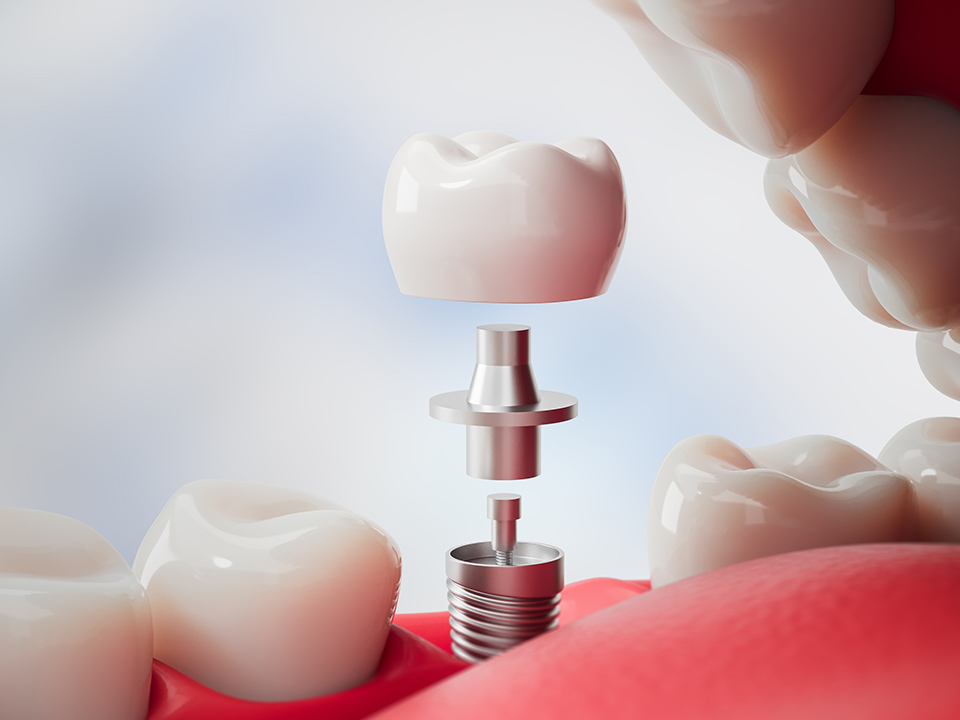
The three pieces
Root, connector, crown
An artificial root — the titanium post, or implant — replaces the root of one missing tooth. The crown is the part that looks like a tooth and does the chewing. Between them sits the abutment, the connector piece that joins the two. Once the implant has fused with the bone — a process called osseointegration — we attach the abutment and crown so you're chewing on it like normal again.
It stands on its own — no grinding down the healthy teeth either side the way a bridge requires.
Day 0
Extract & place
Tooth out, implant in at the same visit when the site allows.
3–4 months
Integration
The bone grows onto the implant. This part cannot be rushed.
Then
Your tooth back
The final crown goes on and you are chewing on it normally.
A common question
What if the tooth has been missing for years?
Very common, and it usually just changes the plan rather than ruling anything out. Bone remodels around a gap over time — the longer a tooth has been missing, the more likely the ridge has narrowed or shrunk in height. The 3D scan shows exactly how much is left. If there's enough, we place directly. If not, we re-evaluate our options.
The honest part
What we can't promise you
We cannot guarantee a fresh extraction site will take an implant
Until the tooth is actually out, nobody knows for certain what the socket looks like underneath. Infection, a wall of bone thinner than the scan suggested, or a socket that won't give the implant the stability it needs — any of these can mean the implant should not go in that day.
When that happens, the more predictable and potentially healthier answer is to graft the site, let it heal, and place the implant later. It adds months. It is still the right answer, because an implant placed into a site that cannot hold it is not a shortcut, it is a failure scheduled for later.
Who does the surgery
Sometimes Dr. Carr, sometimes a surgeon we work with
Dr. Carr performs many implant cases from start to finish here. On some others, he coordinates with a surgeon — because the anatomy calls for it, because the case is overly complex, or because it simply may increase the odds of a better outcome for that patient. Either way, the final crown stays here.
Getting started
How the first visit works
01
Imaging and planning
A 3D scan shows the bone volume, the nerve position and the sinus. That determines whether same-day placement is realistic, whether grafting is likely, and what the whole thing will cost — in writing, before anything is scheduled.
02
Surgery day
Extraction if the tooth is still there, then placement if the site cooperates. Grafting material where it is needed. You will know the plan and the fallback before you sit down.
03
Restoration
Three to four months later, once the implant has integrated. This is where the aesthetic work happens, and it is done here.
Questions
Before you book
Why not just get a traditional bridge for one tooth?
A traditional bridge anchors to the teeth on both sides of the gap by grinding them down to hold crowns. For one missing tooth, that means altering two healthy teeth to fix one problem. A single implant replaces just the missing tooth and leaves its neighbors alone.
My tooth has been missing for years. Can I still get an implant?
Often, yes. Long-missing teeth mean the surrounding bone has typically shrunk, which the 3D scan will show. That may mean a bone graft first, but it rarely rules an implant out entirely.
Am I too old, or is my bone too thin?
Age on its own is rarely the barrier. Bone volume can be, and that is what the 3D scan is for. Thin bone often means a narrower implant rather than no implant at all.
Does it hurt?
Many of our patients tell us implant placement was easier than they expected — and some say it was easier than the extraction. It is done numb, and sedation options are available if the thought of it is what has kept you away.
How long do implants last?
Implants themselves commonly last decades. The crown on top is a normal restoration and may need replacing over that span. What threatens an implant most is gum disease around it and uncontrolled grinding, which is why the cleaning schedule and a night guard matter afterward.
Does it matter if I'm on osteoporosis medication?
It can. Certain osteoporosis medications — bisphosphonates and similar drugs — are linked to slower jaw healing, and that risk tends to rise the longer someone has been on them. If you're taking one, or your doctor is about to start you on one, tell us at your first visit. We may coordinate with your prescribing doctor before finalizing anything.
Does insurance cover implants?
Coverage varies a great deal and is often partial at best. We check your specific plan and give you the real number before anything is scheduled.
Where exactly are you?
2072 E Southern Ave, A103, Tempe, AZ 85282. This building has three dental offices total — A101, A102, and us at A103 — so double-check the suite number if you're using GPS.
Not quite your situation?
Missing 2–3 teeth in a row instead? See implant-supported bridges →
Missing most of your teeth? See All-on-4/All-on-X →
← Back to the Dental Implants overview
For general information beyond what's here: MouthHealthy.org (American Dental Association), and the Arizona State Board of Dental Examiners, where you can verify any dentist's license.
Book
If a tooth is coming out, ask about this first.
The decision about placing an implant is best made before the extraction, not after.
© 2026 Live To Smile. All rights Reserved - Accessibility Statement - Privacy Policy - Sitemap
Managed and Designed by 