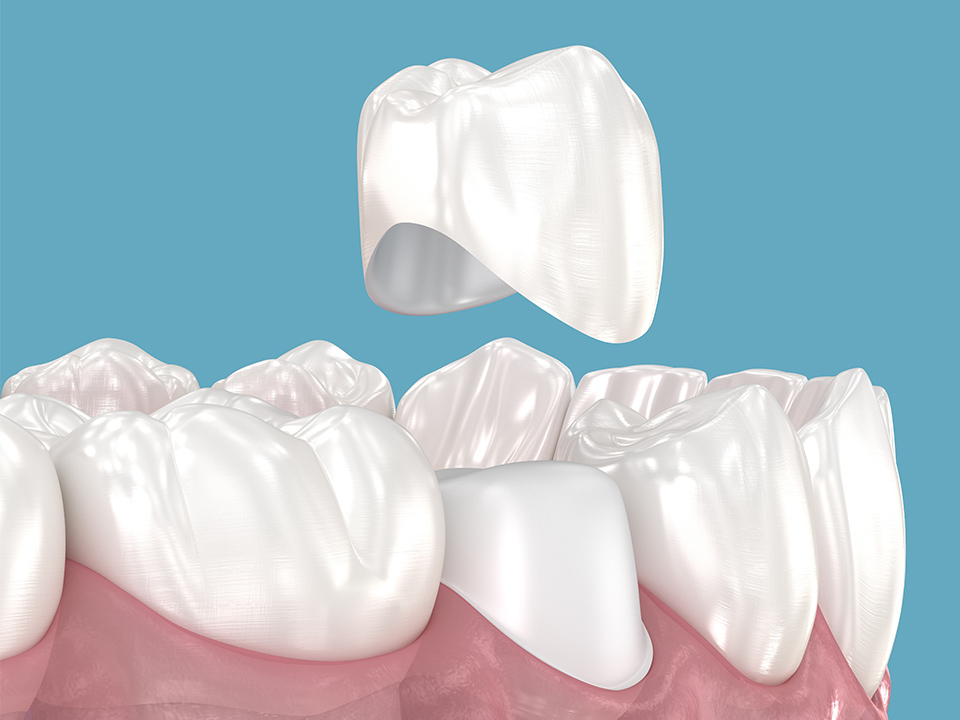
A crown is a cosmetic decision when it is part of your smile.
Then the margin, the shade and the translucency matter exactly as much as they do on a veneer. Same lab, same ceramist, same standard — it just happens to be structural too.
Materials
What your crown is made of depends on your bite
There is no single best crown material. There is a best one for your tooth, your bite, and what is underneath it.
All-porcelain
e.max, LiSi or a similar pressed ceramic — often the same material family we use for veneers. Best light behaviour and the most natural result, which is why it is the default on anything that shows when you smile.
Most natural
Reinforced core with porcelain surface
A stronger core — zirconia or metal — with porcelain layered over the visible face. You get the durability underneath and the appearance on top. This is what heavy grinders get, because all-porcelain on a clenching bite is asking for a fracture.
For Grinders
Opaque core with porcelain surface
Same idea, different reason. A tooth that has had a root canal often darkens from the inside over the years, and translucent porcelain will let that grey show straight through. A more opaque core blocks it, and the porcelain over the top brings the shade back to matching its neighbours.
Masks Dark Teeth
Full zirconia
Extremely strong, less translucent. Reasonable on back molars where the force is highest and nobody is looking at the light behaviour of your second molar.
Back teeth
Two ways to get a crown
Same-day zirconia, or lab-built — not a quality difference, a different job
These aren't a budget option and a premium option. They're two different tools, and which one fits depends on where the tooth is and what it needs to do.
Same-day, in-office zirconia
Milled and seated the same visit, as a courtesy for qualifying cases. Zirconia is genuinely strong — the right call for a back tooth doing real chewing work, or for a patient who grinds and needs something built to take that force. We also offer an aesthetic zirconia option for cases where same-day still matters but the tooth is more visible.
High-end lab-fabricated
Ordered from outside labs chosen specifically for their artistry. The materials are often similar to same-day zirconia — the real differentiator is the ceramist: the shading, the layering, how the porcelain is built up by hand to match the exact tooth next to it. Same paint, different artist. This is the right call for a front tooth where an exact shade match matters more than speed.
The dark tooth problem
Why one front tooth goes grey
It is coming from the inside, not the surface
When a tooth has a root canal, the nerve and blood supply are gone. Over the following years that tooth often darkens — not on the outside where whitening could reach it, but from within the tooth structure itself. Bleaching does not fix it because bleaching is working on the wrong layer.
This is the case people usually arrive frustrated about: one front tooth that no longer matches the others, and a whitening kit that made the situation worse by lifting every tooth except that one.
The answer is a crown with an opaque core to block the dark tooth from showing through, and porcelain layered over it to match the neighbours. Get the core wrong and you can see the grey through the crown. Get it right and nobody can tell which tooth it was.
In practice, that usually means a zirconia core — strong and fully opaque, so nothing dark shows through — with hand-layered feldspathic porcelain built up over it to match the exact shade and translucency of the teeth next to it. It's the same pairing of materials that makes today's crowns capable of looking like veneers: strong where strength is needed, and thin and lifelike everywhere it shows.
We've had cases with two crowns sitting right next to natural veneers, and even the patient couldn't point to which teeth were which once the shade matched. That's the standard we're working toward on every case like this — not just covering the dark tooth, but making it disappear into the smile.
Crown or veneer
Which one you need is not a preference
People often arrive asking for one when the tooth needs the other. It is decided by how much tooth is left and what happened to it, not by budget.
You need a crown
- The tooth has had a root canal
- A large piece has broken off
- There is more filling than tooth left
- The tooth is cracked
- It sits on top of an implant
- A back tooth taking heavy chewing load
A veneer may be enough
- The tooth is healthy and structurally sound
- The issue is shade, shape or width
- Small chips or worn edges
- Gaps you want closed
- Nothing broken, nothing root-canaled
Cosmetic case rather than structural? See the veneer options and pricing →
How it goes
One visit or two
01
Prepare the tooth
Numbed first, then the tooth is shaped so the crown has room to sit without being bulky. If there is decay or an old failing filling underneath, that comes out at the same time
02
Same day, or a temporary
Which one, for you, depends on the case — see same-day zirconia vs. lab-built above.
03
Fit and cement
We check the fit, the margin and the bite before anything is cemented. A crown that is a fraction high will announce itself every time you close, so this part is not rushed.
Questions
Before you book
Does insurance cover a crown?
Usually in part, because a crown is restorative rather than cosmetic. The share varies by plan and there is often an annual maximum in play. We check your specific coverage and give you the number before we start.
How long do crowns last?
Commonly a decade or more with good care. What shortens it is grinding, an untreated bite problem, or decay starting at the margin where the crown meets the tooth — which is why flossing that edge matters more than people expect.
Do I need a crown after every root canal?
Not always, but often, and almost always on back teeth. A root-canaled tooth is more brittle than a living one and back teeth take the most force. On a front tooth with plenty of structure left, a filling is sometimes enough — we will tell you which one you are.
Can I get a same-day crown?
For qualifying cases, yes, as a courtesy. Not every case qualifies — a front tooth needing a precise shade match is usually better served by a ceramist than a same-day mill, and we would rather tell you that than hand you a fast crown that does not match.
My crown came off. Is that an emergency?
Call today. Keep the crown — it can often be re-cemented. Do not use superglue, and avoid chewing on that side until you are seen. More on emergency care →
Where exactly are you?
2072 E Southern Ave A103, Tempe, AZ 85282. Two other dental offices share this building — Suites A101 and A102 — so look specifically for A103.
For general information beyond what's here: MouthHealthy.org (American Dental Association), and the Arizona State Board of Dental Examiners, where you can verify any dentist's license.
Book
Find out what the tooth actually needs.
Sometimes it is a filling. We will tell you if it is.
© 2026 Live To Smile. All rights Reserved - Accessibility Statement - Privacy Policy - Sitemap
Managed and Designed by 