
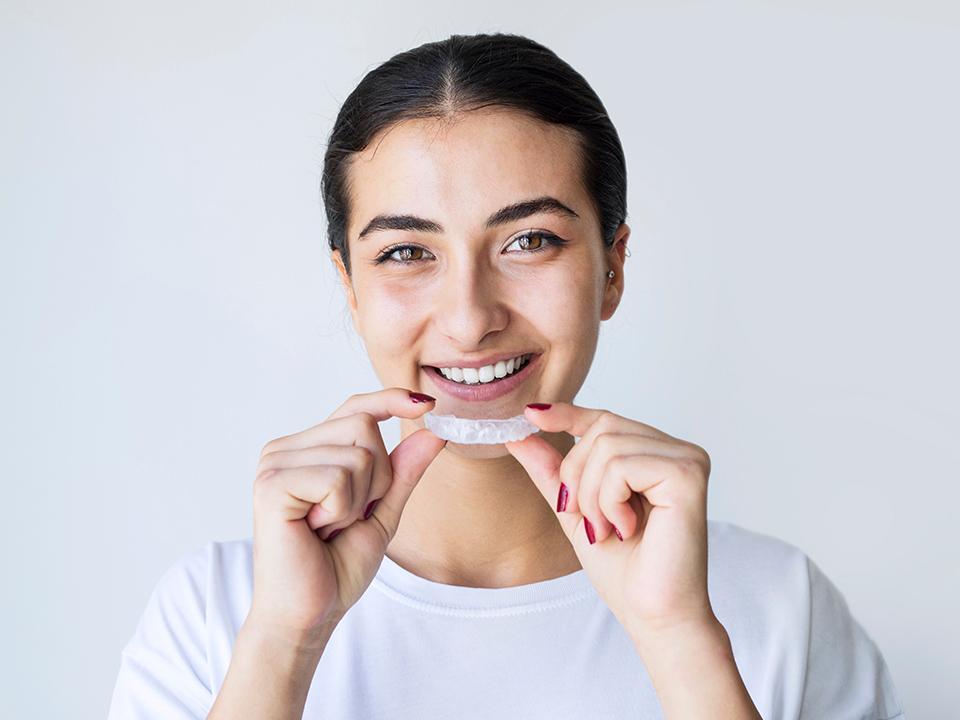
A guard is cheap insurance for expensive dentistry.
Ceramic is strong but not indestructible, and it never chips on a convenient tooth. If you have invested in cosmetic or restorative work, protection matters more — not less.
What we actually do
Not the same appliance for everybody
What we recommend depends on what your mouth is doing at night.
A real exam first
We look at your wear patterns, your bite, your jaw muscles and your existing dental work. Where the wear is tells us a great deal about what is happening while you sleep.
The right appliance for your situation
A traditional occlusal guard is the sturdier option and usually our first recommendation — thicker, more wear-resistant, adjustable. For some patients a thinner clear appliance makes more sense. We will explain the trade-offs honestly rather than defaulting to one answer.
Custom-made, not off the shelf
A guard that does not fit your bite properly can move teeth you did not want moved. That is not a theoretical risk.
A conversation about the cause
An appliance protects your teeth from damage. It does not usually address why the grinding is happening — and sometimes the reason matters a great deal. Not every jaw problem is solved by an appliance, and not everything is predictable. If your situation calls for a dentist with advanced TMJ training or an orofacial pain specialist, we would rather tell you that than hand you a guard and hope.
The thickness question
Why guards are bulky, and why that's the point
Patients ask this constantly. It is a fair question, and there is a real answer.
It is not padding. It is leverage.
A thicker appliance props your jaw slightly more open, and that does two things. It gives your teeth more material to wear through before anything reaches enamel. And it stretches your masseter — the big muscle on the side of your jaw that generates most of the grinding force.
A stretched muscle generally cannot produce as much force as one at its ideal length. Same reason it is hard to squeeze something with your hand wide open, and easy with your fingers curled.
So the bulk is not an inconvenience we tolerate. It may be putting your grinding muscles at a mechanical disadvantage.
Wear on the appliance is wear that did not land on your enamel.
Related: Vertical Dimension — the same principle applied to rebuilding a bite that has already worn down.
Signs
Worth getting checked
You do not need all of them. One or two is enough reason to have it looked at.
- Waking with a sore or tired jaw
- Morning headaches, often at the temples
- Flattened, chipped, or worn-looking teeth
- Teeth that feel sensitive with no obvious cavity
- A partner who hears grinding at night
- Cracked or chipping veneers, crowns, or fillings
- Jaw clicking, popping, or difficulty opening
If you've had cosmetic work
Have veneers, crowns, or implants?
Protection matters more, not less
Ceramic restorations are strong but not indestructible. Repeated heavy force contributes to chipping, cracking and bond breakdown over time — and ceramic never chips on a convenient tooth.
If you have invested in cosmetic or restorative work, a properly made guard is cheap insurance for expensive dentistry. This is why a nightguard is part of the conversation on every veneer case here rather than an afterthought.
Questions
Frequently asked
How much does a night guard cost in Tempe?
How long does it take to get one?
Typically two visits — one to take records of your bite, one to deliver and adjust the appliance. The adjustment matters; a guard that has not been fitted to your bite is not doing its job properly.You can. Whether it fits your bite, covers the right teeth, or suits your situation is a different question, and a poorly fitting appliance can move teeth you did not intend to move. Boil-and-bite guards are better than nothing for some people, but they are not equivalent to a custom appliance.
Why are night guards so thick?
The thickness gives your teeth more material to wear through and stretches the jaw-closing muscles, which may reduce how much force they can generate. It is doing real work.
How long will a night guard last?
It varies widely with how heavily you grind. Some patients wear through a thin appliance in about six months; others get years. Wear on the appliance is wear that did not land on your enamel.
Does insurance cover night guards?
Many plans offer partial coverage. We can check your benefits before you commit to anything. More on ways to pay →
Can grinding be a sign of something else?
Sometimes. Nighttime grinding has been associated with sleep-disordered breathing, and certain medications have been associated with increased clenching. Worth discussing at your visit.
Where exactly are you?
2072 E Southern Ave A103, Tempe, AZ 85282. Two other dental offices share this building — Suites A101 and A102 — so look specifically for A103.
Learn more
A series on grinding and protection
01
The Best Night Guard Is the One You Actually Wear
Guards vs. clear retainers, and the honest trade-offs.
02
Your Jaw Might Be Grinding Because You Can't Breathe
The sleep apnea connection.
03
Cheap Insurance for Expensive Dentistry
Protecting veneers and crowns.
04
Can Your Antidepressant Make You Grind Your Teeth?
The medication link.
05
Botox for Clenching: The "Chemical Night Guard"
What it does and doesn't do.
For general information beyond what's here: MouthHealthy.org (American Dental Association), and the Arizona State Board of Dental Examiners, where you can verify any dentist's license.
Get looked at
Most people find out from a dentist, not from themselves.
Serving Tempe, Chandler, Mesa, Scottsdale and the greater Phoenix area.
© 2026 Live To Smile. All rights Reserved - Accessibility Statement - Privacy Policy - Sitemap
Managed and Designed by 